How Invoicing Works: Your Finance Dashboard
Create and send your first invoice, then log expenses, manual income, and mileage — all from one HMRC-compliant Finance Dashboard.
Finance Dashboard: Your Complete Financial Command Centre
The Finance Dashboard is your single source of truth for all money flowing in and out of your childminding business. From invoice tracking to HMRC-compliant expense logging, everything you need to stay on top of your finances lives here.
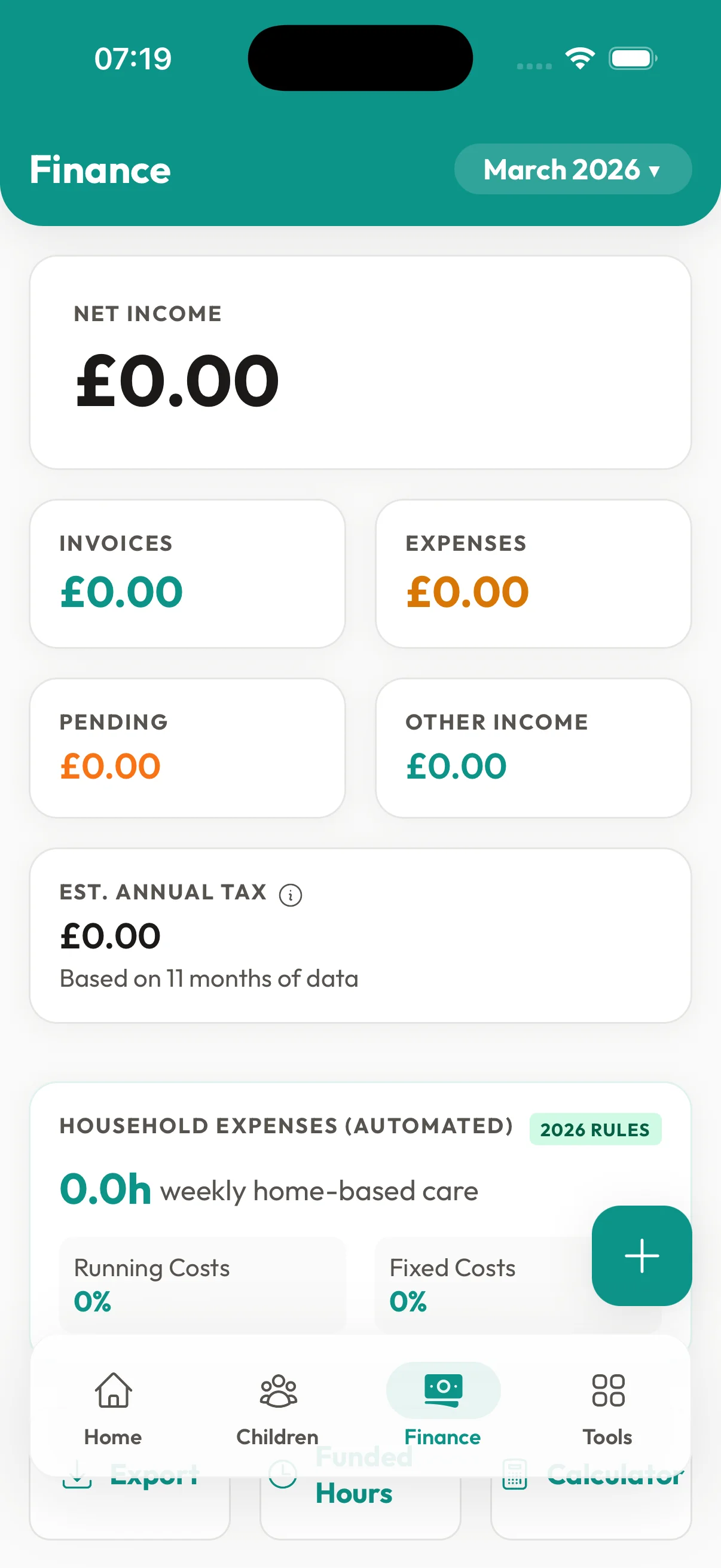
Finance Dashboard Overview
Understanding Your Net Income Card
The Net Income card at the top of your dashboard shows your monthly profit at a glance — your total income minus your total expenses for the selected month. If you're running at a loss, the figure turns red so it's easy to spot.
Underneath, a compact Est. annual tax row projects your yearly tax bill based on your income so far. Tap the info icon next to it to see how the estimate is calculated.
💡Why This Matters
Tax Season Made Simple
Your Net Income figure goes straight into your Self-Assessment tax return. With accurate tracking all year, January becomes stress-free.
Your Financial Snapshot
Below the Net Income card, four tappable cards give you a breakdown for the month:
1. Invoices
Your total invoice income for the month. Tap the card to open the full invoice list, where you can filter by parent or payment status.
2. Expenses
Your total logged business spending for the month. Tap the card to see every expense with its receipt.
3. Awaiting Payment
Invoices that have been sent but not yet marked as paid. Tap to jump straight to the sent invoices so you can chase them up.
4. Other Income
Non-invoice income you've logged — Local Authority funding payments, government grants, retainer fees, Tax-Free Childcare top-ups, and anything else that doesn't go through an invoice. Tap to see the full manual income history.
Below the cards, a Year Overview link takes you to a month-by-month breakdown for the whole year.
Invoice Coverage: Did Everyone Get Billed?
Below the Year Overview link, an Invoice Coverage card checks whether every child was billed for the last completed month. It tags each child Invoiced, Draft, Missing, or Not Required, with a summary count for each. Toggle "Show not required" to bring hidden Not Required children back into the list, and switch the month using the picker in the header. Tap a child marked Missing to jump straight into creating their invoice; tap anyone else to open their existing one.
3-Month Forecast
Below that, the 3-Month Forecast card projects your income for the next three months, based on your children's contracted hours (setting closures are excluded). Collapsed, it shows just the running total; tap it to expand into a month-by-month breakdown split into Private, Consumables, and LA Funded income, with a per-child breakdown for each month. It's a projection from contracts, not actuals, so real income will vary.
The FAB Menu (Floating Action Button)
Tap the + button in the bottom-right corner to access four quick-add actions:
- New Invoice: Bill parents for childcare
- Log Income: Record funding, grants, or retainers
- Log Mileage: Record business travel (petrol reimbursement)
- Log Expense: Track business spending with receipts
Creating Your First Invoice
When you tap "New Invoice" from the FAB menu, here's the complete workflow:
Step 1: Select Child
- Tap a child avatar from the horizontal scroll
- Only children with enrolled status appear
- Child name auto-populates the invoice header
- Parent details are pulled from the child profile
Step 2: Billing Period
- Auto-set to current month by default
- Tap to change if billing for a different month
- Format: "January 2026" (shows clearly on PDF invoice)
- Critical for Tax-Free Childcare claims
Step 3: Add Line Items
Each line item captures:
- Description: What you're charging for (e.g., "Full-time Care", "Extra Hours", "Meals")
- Quantity: How many units (e.g., 1 month, 20 days, 40 hours)
- Rate (£): Price per unit (e.g., 850.00 for monthly fee, 6.50 per hour)
- Amount: Auto-calculated (Quantity × Rate)
Example Line Items:
Description          | Qty  | Rate    | Amount
---------------------|------|---------|--------
Full-time Care       | 1    | 850.00  | £850.00
After-School Club    | 5    | 15.00   | £75.00
Hot Meals            | 20   | 3.50    | £70.00
                                Total: £995.00
Step 4: Review & Save
- Save Draft: Keeps invoice editable, not sent to parent
- Finalise & Send: Locks invoice, emails PDF to parent
- Mark as Paid: Updates payment status (only after sending)
💡Invoice Generation
Smart Billing from Diary
Tap "✨ Generate Line Items" to auto-create line items based on actual attendance logged in your diary. KinderStart counts hours/days and applies contracted rates.
Advanced Billing: Custom Periods & Deposits
For Contract or Actuals billing modes, the Billing Period section offers a Monthly / Weekly / Custom selector:
- Monthly (default): Pick the month with the month selector. A note tells you whether you're billing in advance or in arrears for that month.
- Weekly: Set Number of Weeks — how many weeks each invoice covers (e.g. 4 for four-weekly billing) — plus a Period Start Date. The end date is calculated for you automatically.
- Custom: Pick both a Period Start Date and Period End Date freely.
Termly and Annual billing skip this selector — they charge a flat monthly instalment, so there's no per-day rate to scope to a shorter period. Instead, toggle Fixed Monthly Fee Override to bypass the algorithm and enter your own flat Monthly Private Fee (£).
If a child has a deposit on file — set up via the deposit clause on their contract, see the Contracts & Funding Tracker guide — and some of it remains unspent, a Deposit Available banner appears with an Apply Deposit toggle. Switch it on before generating line items to deduct the remaining deposit from this invoice.
Logging Business Expenses
When you tap "Log Expense" from the FAB menu, capture these details:
Required Fields
-
Date: When the expense occurred (defaults to today)
-
Category: Choose from 50+ HMRC-mapped categories, including:
- Food & Consumables (meals, snacks, nappies)
- Toys & Books
- Office, Phone & Stationery
- Travel & Playgroup Fees
- Household Running Costs (gas, electric, water)
- Household Fixed Costs (rent, council tax)
- Furniture & Household Items
- Repairs & Maintenance
- Advertising & Marketing
- Professional & Legal Fees
- Wages & Assistant Costs
- Other Business Expenses
-
Description: What you bought (e.g., "Weekly groceries for meals", "New toy storage unit", "Printer ink")
-
Amount (£): Total cost including VAT (e.g., 45.50)
-
Receipt Photo: Snap a pic or upload PDF receipt — HMRC requires proof for all business expenses
Optional Fields
- Venue: Home or External (for location tracking)
- Business Use %: For MTD compliance (defaults to 100%)
Special: Household Expenses
When you select "Household Running Costs" or "Household Fixed Costs":
- KinderStart automatically applies HMRC apportionment percentages
- Based on your Weekly Home Hours from Business Settings
- The allowed percentage appears as a badge
- Example: 30 hours/week = 25% of a running cost (like gas) is claimable — running costs and fixed costs use different percentages, see below
Recurring Expenses
If a cost repeats — a phone contract, insurance, a membership renewal — switch on "Recurring Expense" in the expense editor and pick how often it repeats (weekly, monthly, or yearly). KinderStart logs the next occurrence for you automatically, so you don't have to re-enter the same expense every time it's due.
Receipt Requirement
Keep Every Receipt
HMRC requires proof for all business expenses. Photograph receipts immediately. KinderStart stores them securely and links them to your tax export.
Recording Manual Income
When you tap "Log Income" from the FAB menu, capture these details:
Required Fields
-
Date: When income was received (defaults to today)
-
Category: Choose the income type:
- Local Authority Funding: 2, 3, or 4-year-old funded hours payments
- Government Grant: Business support grants, startup funding
- Retainer Fee: Monthly retainer from parents during holidays
- Tax-Free Childcare Top-up: TFC government contribution (20%)
- Other Income: Any other business income not from invoices
-
Amount (£): Total received (e.g., 1200.00)
-
Description: What this income is for (e.g., "2 and 3 year old funding - Spring term", "Childminder Grant Q1 2026")
Optional Fields (Recommended)
- Attachment: Upload proof document (bank statement, payment notification letter)
- This creates an audit trail for HMRC compliance
Why Manual Income Tracking Matters
- Funding doesn't go through invoices: Local Authority pays you directly
- Grants aren't taxed the same way: Different treatment on Self-Assessment
- Retainers need separate tracking: For contract compliance and holiday pay records
- TFC top-ups must be recorded: Proves income sources for mortgage applications
✅Funding Badge
HMRC-Compliant Categories
Each income category has a distinct badge color and automatically maps to the correct box on your Self-Assessment tax return. No manual sorting needed at year-end.
Recent Transactions Feed
Below the cards, you'll see your chronological activity:
- Each transaction shows date, description, amount, and category
- Green = money in (income/invoices)
- Red = money out (expenses)
- Tap any transaction to view full details or edit
Transaction Filters
Use the filter icon to show:
- All: Every financial transaction
- Income Only: Invoices + manual income
- Expenses Only: Business spending
- This Month: Current billing period
- Custom Range: Select specific dates
Month Selector
The dropdown at the top lets you switch between months:
- Current Month: Default view
- Previous Months: Historical data for any past month
- Tax Year View: See April-to-April totals for Self-Assessment
HMRC Deduction Percentages
Based on your Weekly Home Hours, KinderStart automatically applies the correct HMRC percentage for household expenses — and running costs and fixed costs are worked out differently, so they're not the same percentage at a given number of hours:
| Weekly Hours | Running Costs (gas, electricity, water, broadband) | Fixed Costs (rent, mortgage interest, buildings insurance) |
|---|---|---|
| Under 10 hours | 0% | 0% |
| 10 hours | 9% | 3% |
| 20 hours | 17% | 5% |
| 30 hours | 25% | 8% |
| 40+ hours | 33% (maximum) | 10% (maximum) |
Running costs rise roughly in step with your hours up to a 33% ceiling; fixed costs rise more slowly and cap at 10% — so at any given hours figure, the two percentages are genuinely different from each other, not a single blended rate. These percentages appear automatically when you log household expenses like gas, electricity, water, rent, or council tax, based on the Standard Weekly Hours or actual logged attendance set in Business Settings.
Understanding Your Financial Health
Green Zone (Healthy)
- Invoices paid on time
- Regular expense tracking
- Steady net income growth
Yellow Zone (Monitor)
- Some overdue invoices
- Irregular expense logging
- Fluctuating monthly income
Red Zone (Action Needed)
- Multiple overdue invoices
- Missing expense receipts
- Negative net income
✅Pro Tip
Weekly Finance Check
Spend 10 minutes every Monday reviewing your dashboard. Mark invoices as paid, log any cash expenses, and ensure receipts are uploaded. This weekly habit prevents year-end chaos.
Export & Reports
From the Finance Dashboard, tap the export icon to open the export sheet. Choose a date range and whether you want Income, Expenses, or both, preview what's included, then tap Download CSV — this is a single, flexible CSV export rather than a set of separate named reports, so the same tool covers handing figures to your accountant or pulling a year's data for Self-Assessment.
Revenue Streams: Private vs. Government Grant
Every invoice line item in KinderStart is tagged with a revenue stream:
- Private Parent Fees (SALES_SERVICES): Your private hourly rate, extras, consumables — income taxable as self-employment earnings
- Government Grant (GOVT_GRANT): LA-funded hours — income received directly from your Local Authority, reported separately
This split matters for Making Tax Digital (MTD). From 2026, HMRC requires digital records that separately identify your income sources. The monthly CSV export from the invoice list pre-separates these streams, so your accountant (or your MTD software) receives correctly classified data without any manual sorting.
The Finance Dashboard net income figure includes both streams in the total, but the export lets you see and report on each independently.
Connected Features
The Finance Dashboard pulls data from:
- Contracts: Hourly rates, funding types, billing modes, and recurring extras
- Attendance Diary: Actual hours worked for ACTUALS-mode billing
- Business Settings: Tax apportionment rules, funded hours window, LA rate cards
- Children: Parent contact for invoice delivery and portal access
Everything connects. When you log an attendance session, update a contract rate, or add a recurring expense, the Finance Dashboard reflects it immediately — no double-entry, no spreadsheets.
Next in your getting-started series
Mastering the Daily Diary
Ready to try KinderStart?
Start your free trial and put these guides into action.
Subscribe to start your 7-day free trial • Cancel anytime
KinderStart strives for accuracy. Competitor features and pricing comparisons are based on publicly available information as of May 2026. Details are subject to change by respective providers.