How to Become a Childminder in the UK (2026): Registration Steps and Ofsted Readiness
KinderStart Team
2026-10-06 • 6 min read
Key Takeaways
 Key Takeaways
Becoming a childminder means turning your home and your experience with children into a registered, regulated early years business. The route is well defined, but it has several moving parts: training, checks, an Ofsted application, tax registration and, once registered, an inspection. This guide gives you the sequence in plain terms. For the full overview, see our pillar guide, How to Become a Childminder.
✅Bottom Line Up Front (BLUF)
To become a childminder in England you must register with Ofsted (or a childminder agency), hold an enhanced DBS check and paediatric first aid certificate, complete safeguarding and EYFS training, and have a safe home setting. Once registered, you work to the EYFS statutory framework and are inspected by Ofsted, so keep your records inspection-ready from day one.
TL;DR
- You must register if you care for children under eight, for reward, for more than two hours a day.
- Core requirements: enhanced DBS, paediatric first aid, safeguarding and EYFS training, health declaration, suitable premises.
- Childminders may care for up to six children under eight, with no more than three under five (check the framework for exceptions).
- Registration is followed by tax registration with HMRC as self-employed, and food business registration if you provide food.
- The EYFS puts responsive, high-quality interactions at the heart of daily practice.
- Prepare for inspection early: documentation gaps are the most avoidable problem.
- The September 2026 EYFS document should be read in full from the official source before you finalise policies.
Who needs to register as a childminder in the UK?
Anyone in England who looks after children under eight, usually in their own home, for more than two hours a day and for reward must register with Ofsted or a childminder agency. Looking after children without payment, or only relatives' children, does not usually require registration. Working unregistered can be a criminal offence.
The legal basis is the Childcare Act 2006. Scotland, Wales and Northern Ireland have separate regulators and rules, so this guide covers England only. The government's own overview is at gov.uk/become-childminder-nanny.
What do you need before you can register with Ofsted?
You need an enhanced DBS check, a valid paediatric first aid certificate, completed safeguarding and EYFS training, a health declaration, and suitable, safe premises. Everyone aged 16 or over in your household also needs checks. Ofsted also expects you to complete its pre-registration briefing.
| Requirement | What it means in practice |
|---|---|
| Enhanced DBS | Applied for through the Disclosure and Barring Service; household members aged 16+ are checked too |
| Paediatric first aid | A course suitable for early years, kept in date |
| Safeguarding and EYFS training | Shows you understand your duties before you work alone with children |
| Health declaration | Confirms you are physically and mentally fit to care for children |
| Suitable premises | A safe, clean home with risk assessments in place |
Public liability insurance is not covered in the sources used for this guide, but most childminders take it out as standard good practice. Confirm the current position with your insurer and Ofsted.
How many children can a childminder look after?
A registered childminder can care for up to six children under eight at once, including their own. No more than three of those may be young children, meaning under five. Exceptions exist, so check the current EYFS statutory framework before planning your numbers.
Your ratios shape your income, your waiting list and your funding plans, so work them out before you apply. Our Ofsted ratios guide walks through typical combinations. The framework itself is published on GOV.UK as the EYFS statutory framework.
⚠️Read the September 2026 EYFS from the source
The DfE has published EYFS guidance for group and school-based providers from September 2026. We could not extract its detailed content when preparing this guide, so we have not quoted specific changes. Read the official document and the childminder version of the framework directly, and check which parts apply to home-based providers.
What are the steps to become a childminder?
Complete pre-registration training and first aid, apply to Ofsted or a childminder agency, pass DBS and suitability checks, and host a registration visit. Register with HMRC as self-employed, and get your insurance in place. Once registered, Ofsted inspects you against the EYFS.
Paediatric first aid, safeguarding and EYFS training, plus the Ofsted pre-registration briefing.
Submit your application and DBS checks for you and your household to Ofsted or an agency.
Complete risk assessments, safe sleep arrangements and policies before the registration visit.
Tell HMRC you are self-employed via [Self Assessment registration](https://www.gov.uk/register-for-self-assessment), and register with your council if you provide food ([food business registration](https://www.gov.uk/food-business-registration)).
Begin once you receive your registration, working to the EYFS.
Ofsted inspects your setting, so keep records current from the first day.
For a detailed walkthrough of the application itself, use our Ofsted registration step-by-step guide. Timescales vary, so build in several weeks and do not give notice on other work until your registration is confirmed.
What does the EYFS expect of you day to day?
The EYFS expects you to support children's communication and language through responsive, high-quality interactions: listening actively, asking open questions, repeating and extending what children say, and noticing non-verbal communication. These interactions form a core part of how your practice is assessed and observed.
The Department for Education's interactions guidance sets out these behaviours under Communication and Language. In practice, this means getting down to a child's level, giving them time to respond, and building on what they say rather than correcting it. Our EYFS statutory framework guide explains how this fits with the other areas of learning.
How do you prepare for your first Ofsted inspection?
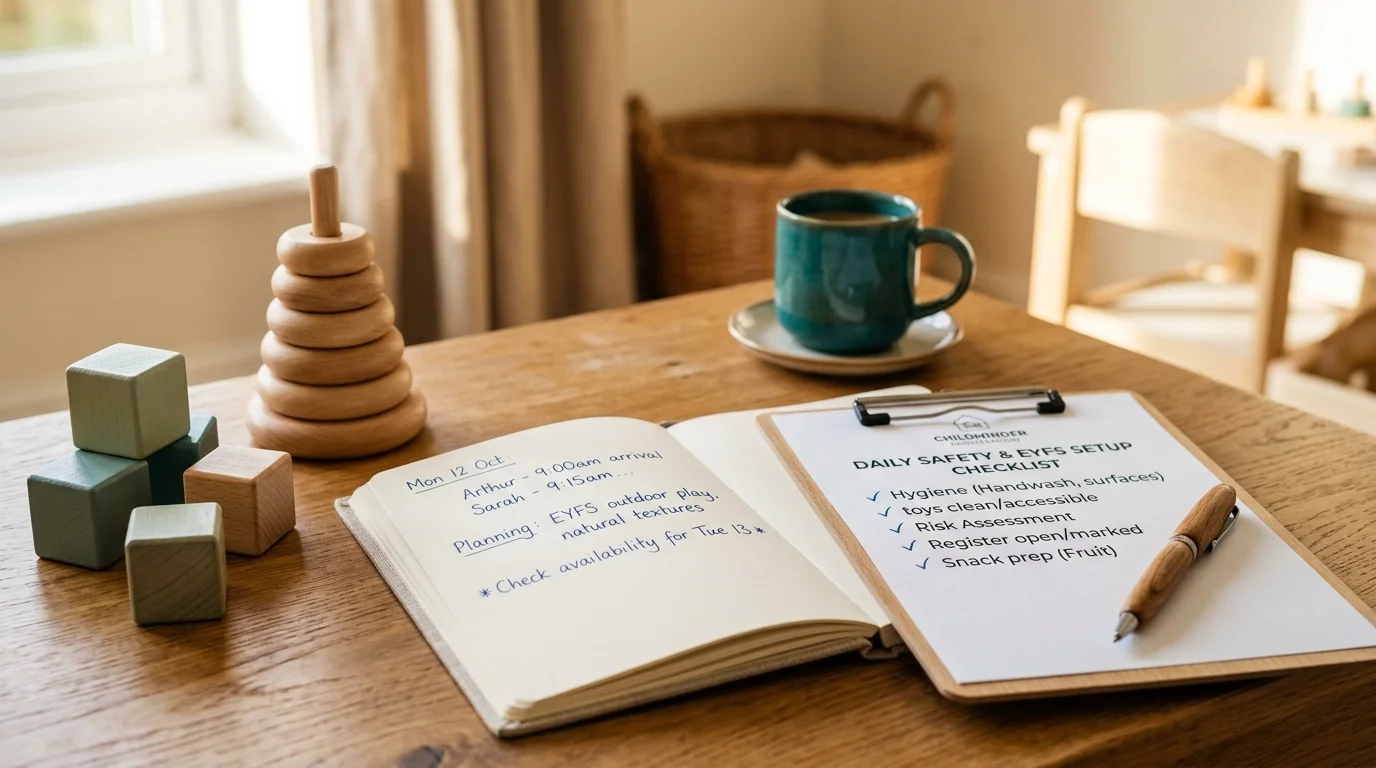
Prepare by reading the EYFS and Ofsted's current early years inspection handbook, keeping policies, registers, risk assessments and child records up to date, and rehearsing how you explain your practice. Gaps in paperwork are easier to fix before an inspector asks to see them.
A practical approach is to test yourself against each inspection area, note what evidence you could show today, and fix whatever is missing. Documentation is where new childminders most often lose confidence, because it is easy to practise well and still struggle to show it.
Run a mock inspection before the real one
 Run a mock inspection before the real one
Set aside an hour each month to walk through your setting as an inspector would: registers, policies, risk assessments, observations and safeguarding records. Write down every gap and close it before the next review.
Ofsted Inspection Simulator
Walk through official inspection domains, spot documentation gaps before inspectors arrive, and keep your setting audit-ready.
Explore the Ofsted Inspection Simulator | Download KinderStart
FAQ
Who needs to register as a childminder in the UK?
In England, anyone looking after children under eight, usually in their own home, for more than two hours a day and for reward must register with Ofsted or a childminder agency. Caring only for relatives' children or without payment does not usually require registration.
What do you need before you can register with Ofsted?
You need an enhanced DBS check, a valid paediatric first aid certificate, safeguarding and EYFS training, a health declaration, and suitable, safe premises. Everyone aged 16 or over in your household also needs checks, and Ofsted expects you to complete its pre-registration briefing.
How many children can a childminder look after?
A registered childminder can care for up to six children under eight at once, including their own, and no more than three of those may be young children under five. Exceptions exist, so check the current EYFS statutory framework before planning your numbers.
How do you prepare for your first Ofsted inspection?
Read the EYFS and Ofsted's current early years inspection handbook, keep policies, registers, risk assessments and child records up to date, and rehearse how you explain your practice. Fixing paperwork gaps beforehand is far easier than explaining them during the inspection.
 Try Our Free Tools