New EYFS Statutory Framework (September 2026): What Every Childminder Needs to Know
Daniel Broadhurst (Founder)
Sep 15, 2026 • 7 min read
Key Takeaways
On 1 September 2026, the Department for Education (DfE) brought into force an updated statutory framework for early years providers across England. For registered childminders, these changes represent the most significant welfare and safeguarding overhaul since the 2024 ratio flexibilities. For foundational curriculum context, see our complete EYFS Statutory Framework Guide.
Unlike non-statutory advice such as Development Matters, compliance with the EYFS Statutory Framework for Childminders is a mandatory condition of your Ofsted or Childminder Agency (CMA) registration under the Childcare Act 2006. Failing to meet these updated standards can lead directly to enforcement action, setting suspension, or registration cancellation.
✅Bottom Line Up Front (BLUF)
Effective 1 September 2026, the DfE has updated the EYFS Statutory Framework for childminders with mandatory new welfare requirements. Key changes include explicit safer sleep rules written directly into the framework, an outright ban on registered childcare where banned dog breeds are present, lowering the Ofsted/CMA reporting threshold from 'serious harm' to any 'harm', and new statutory duties regarding children's screen time.
TL;DR
- Safer Sleep in Main Framework: Explicit cot specifications, firm mattresses, and regular recorded sleep checks are now direct statutory requirements.
- Banned Dog Breeds Prohibited: Childcare cannot be delivered on any domestic premises where an XL Bully or other banned breed lives or visits.
- Lowered Harm Threshold: Childminders must notify Ofsted or their CMA of allegations of "harm" (previously "serious harm") within 14 days.
- Screen Time Governance: Settings must "have regard to children's screen use" and ensure passive digital media does not displace physical play.
- Mandatory Volunteer Checks: Enhanced DBS checks are now compulsory for all volunteers; new staff cannot start before DBS certificates arrive.
- Monthly Funding from October 2026: Local authorities must offer childminders monthly entitlement payments starting 1 October 2026.
- KinderStart Compliance Automation: Log digital sleep checks in seconds and track exact attendance times with zero paperwork.
What are the September 2026 changes to the EYFS Statutory Framework?
On 1 September 2026, the Department for Education implemented statutory revisions to the EYFS framework for childminders in England. The updates mandate explicit safer sleep standards, ban registered childcare on premises with dangerous dog breeds, lower Ofsted incident notification thresholds from 'serious harm' to 'harm', and require formal policies regarding early years screen use.
The DfE and Ofsted introduced these statutory amendments to address emerging safeguarding risks and provide absolute legal clarity for home-based practitioners. Key highlights include:
- Integration of Safer Sleep: Sleep guidance is no longer an external recommendation; it is embedded directly in statutory welfare requirements.
- Dangerous Dogs Prohibition: Zero tolerance for banned dog breeds on childcare premises.
- Early Safeguarding Intervention: The lowering of notification thresholds from "serious harm" to "harm" gives statutory agencies earlier visibility of potential domestic risks.
- Digital Wellbeing: Clear guidance on device limits to safeguard language development and gross motor milestones.
What are the new statutory safer sleep rules for childminders?
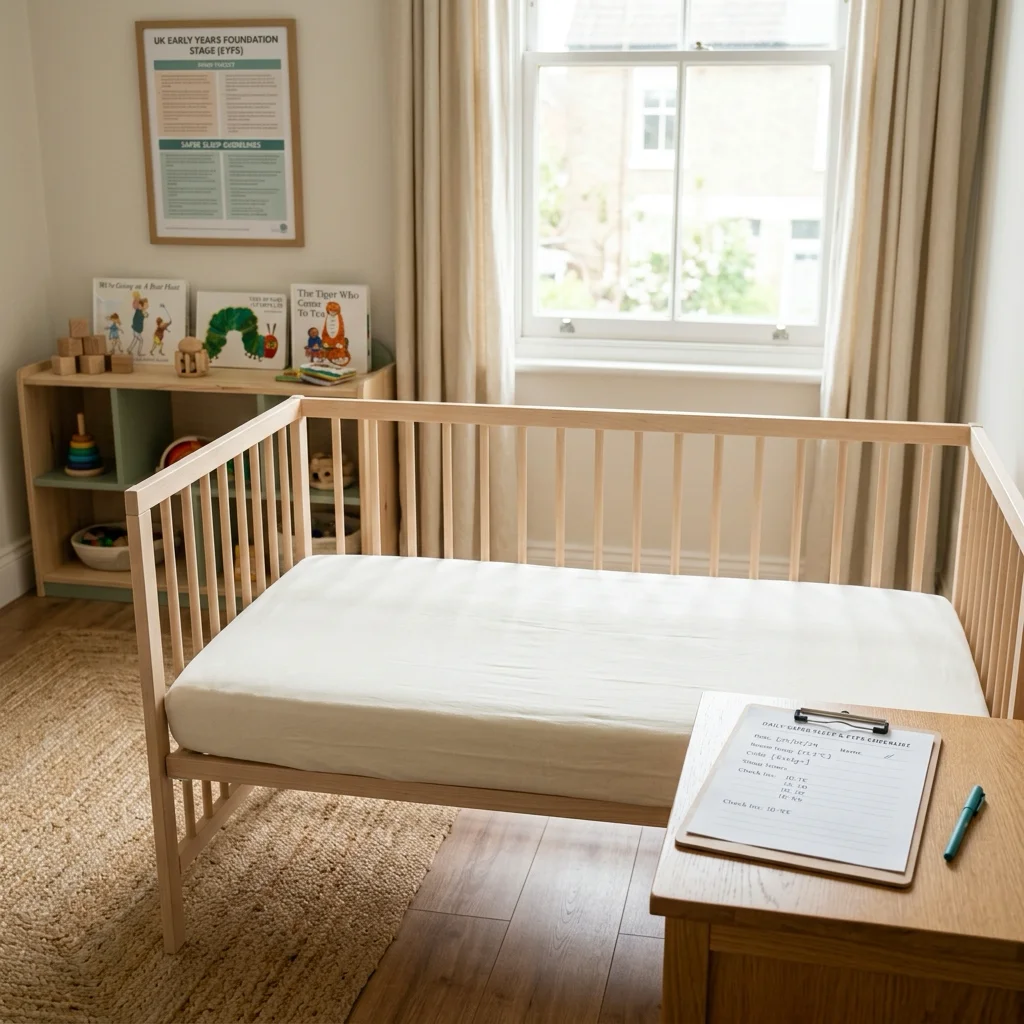
The September 2026 EYFS update moves safer sleep guidance directly into statutory law. Childminders must provide safe, flat sleep spaces with firm, well-fitted mattresses, conduct and log frequent physical checks for breathing and temperature, and ensure sleep environments are free from loose blankets, cot bumpers, bibs, and bottles.
Previously, providers were expected to "have regard to" external NHS and Lullaby Trust advice. Under the September 2026 text, childminders must meet strict statutory criteria in their home settings:
- Safe Sleep Surface: Babies and toddlers must sleep in dedicated cots, Moses baskets, or travel cots that comply with British Safety Standards (BS EN 716). Mattresses must be clean, firm, flat, and waterproof.
- Clear Sleep Spaces: Pillows, duvets, padded cot bumpers, soft toys, and bibs are strictly forbidden in cots to prevent overheating and accidental suffocation.
- Sleep Position: Infants must always be placed on their back to sleep, unless a GP provides specific, written medical dispensation.
- Physical Checks & Monitoring: While audio baby monitors can assist, they do not replace in-person physical checks. You must inspect sleeping children regularly (recommended every 10–15 minutes) to verify normal breathing, chest movement, and body temperature.
Using a digital daily register like KinderStart allows childminders to log nap checks with a single tap, creating an auditable timeline that proves compliance during your next Ofsted inspection.
Which dog breeds are prohibited on childminder premises under the 2026 EYFS?
Under the 2026 EYFS framework, childminders are strictly prohibited from providing registered childcare from any premises where a banned dog breed is kept or present. This ban covers all breeds listed under the Dangerous Dogs Act 1991, including the XL Bully, Pit Bull Terrier, Japanese Tosa, Dogo Argentino, and Fila Brasileiro.
Following the UK Government's ban on American Bully XL dogs under the Dangerous Dogs Act 1991, the DfE has updated the EYFS to make it an explicit registration violation to care for children on premises where any prohibited breed resides:
| Dog Breed | Legal Status under Dangerous Dogs Act | EYFS 2026 Childcare Status |
|---|---|---|
| American Bully XL | Banned breed | Strictly Prohibited on childcare premises |
| Pit Bull Terrier | Banned breed | Strictly Prohibited on childcare premises |
| Japanese Tosa | Banned breed | Strictly Prohibited on childcare premises |
| Dogo Argentino | Banned breed | Strictly Prohibited on childcare premises |
| Fila Brasileiro | Banned breed | Strictly Prohibited on childcare premises |
| Other Pet Breeds | Permitted with dynamic risk assessment | Permitted if supervised and risk-assessed |
Even if a dog has a Certificate of Exemption, valid third-party insurance, and is kept securely in another room, registered childcare cannot take place on the premises. Childminders with permitted pet dogs must continue to maintain dynamic risk assessments, ensure animals are never left unsupervised with children, and keep pet food and feeding bowls out of children's reach.
For a refresher on daily environmental safety protocols, review our Childminder 30-Second Risk Assessment Checklist.
When must childminders report allegations of harm to Ofsted or their CMA?
The DfE has lowered the statutory notification threshold from 'serious harm' to any allegation of 'harm'. Childminders must notify Ofsted or their childminder agency within 14 days of any allegation or incident involving harm or abuse committed by anyone who lives, works, or looks after children on the premises.
In previous iterations of the framework, notifications were only mandated for allegations of serious harm. In practice, childminders were often left uncertain whether a minor domestic dispute or low-level complaint reached the legal bar of "serious". The removal of the word "serious" eliminates ambiguity:
- Who is Covered: The childminder, assistants, household members, domestic lodgers, regular visitors, and anyone aged 16 or over residing on the premises.
- What Must Be Reported: Any incident or allegation involving harm, abuse, neglect, or physical altercations, regardless of whether children were present at the time.
- Timescale: You must notify Ofsted or your CMA as soon as reasonably practicable, and no later than 14 calendar days after the incident or allegation arose. Failure to notify within 14 days is a criminal offence under Section 76 of the Childcare Act 2006.
To ensure your setting remains compliant when recording day-to-day injuries or pre-existing bruises, see our guide on Voice of the Child and Pre-Existing Injuries.
What are the new statutory expectations for children's screen use?
The 2026 framework introduces a statutory requirement for early years providers to have regard to children's screen use. Childminders must ensure digital devices do not displace active physical play, outdoor exploration, or interactive language development, maintaining clear, age-appropriate limits and sharing their screen policy with parents.
Digital tablets and televisions are common in domestic households, but the September 2026 EYFS update establishes firm boundaries for professional childcare:
- Purposeful Learning Only: Screen use must have a clear educational objective, such as looking up an insect identified during a park visit or exploring interactive phonics songs.
- Zero Passive Viewing for Under-2s: In line with NHS and paediatric guidance, screen time for infants and children under two should be avoided entirely during childcare hours.
- No Displacement of Active Play: Screens must never replace messy play, sensory exploration, or outdoor garden time.
- Transparent Parent Policy: Your written setting policies must state whether screens are used, for what duration, and under what supervision rules.
What new volunteer and assistant recruitment checks are mandatory?
Under the September 2026 framework, childminders must obtain an Enhanced DBS check for all volunteers before they begin supporting the setting, even if they are closely supervised. Furthermore, new assistants or employees are strictly prohibited from commencing employment until their full Enhanced DBS certificate has been received and verified.
If you employ an assistant or have students on placement, note these strengthened safer recruitment duties:
- No Starting on Pending Checks: Assistants cannot shadow you, assist with mealtimes, or enter the premises during childcare hours while their DBS application is in progress.
- Volunteers Included: Unpaid volunteers, including family members who assist with school runs, must have an Enhanced DBS with Barred List check.
- Ongoing Suitability Disclosure: You must formally inform all staff and assistants of their statutory duty to disclose any police cautions, court convictions, or domestic orders that could affect their suitability.
For advice on hiring staff and managing employment contracts, read our Childminder Assistant Training & Funding Guide and our Assistant Cover & Sickness Guide.
When do mandatory monthly funding payments start for childminders?
From 1 October 2026, all English local authorities are legally required to offer early years providers, including childminders, the option to receive their government funding entitlements in regular monthly instalments. This change ends termly cash-flow droughts and is paired with a 97% local funding pass-through mandate.
For years, independent childminders have shouldered significant personal debt waiting for lump-sum council payments at the start or middle of each 12-week term. Under the new statutory funding regulations:
- Monthly Option: Councils can no longer restrict childminders to termly payments. You have the statutory right to request 12 equal monthly instalments.
- 97% Pass-Through Rate: Local authorities must pass through at least 97% of their central DfE funding allocation directly to early years providers, reducing bureaucratic council top-slicing.
- Termly Headcounts: Funding for 3- and 4-year-olds is calculated using consistent termly census counts, simplifying stretched entitlement forecasts.
📱 Digital Attendance & Sleep Checks Built for Childminders
Record sleep intervals, log exact-minute arrival times, and document safeguarding notes in seconds with KinderStart's one-handed mobile app.
Remain 100% Compliant with KinderStart
Keeping up with constant DfE legislative updates shouldn't mean spending your evenings buried in paperwork. KinderStart is designed specifically for independent UK childminders, automating statutory compliance so you can focus on what matters most: nurturing young children.
From automated sleep check logs and exact-minute attendance registers to MTD-ready invoicing and EYFS curriculum tagging, KinderStart keeps your setting audit-ready every single day.
Ready to simplify your childminding business? Explore KinderStart's features today or download the app on iOS and Android.
Related statutory reading:
-
Business Growth for Childminders 2026: EYFS Statutory Guidance and How to Scale Safely
-
Childminder Sickness Policy & Assistant Cover Guide: Contracts, Fees & 2026 EYFS Rules
-
Childminder Assistant Ratios 2026: Calculating Your New Capacity
Related statutory reading:
Related statutory reading:
Related statutory reading:
Related statutory reading: