The Ultimate 2026 Checklist for Ofsted Registration (with Costs)
Daniel Broadhurst
2026-09-15 • 10 min read
Key Takeaways
The Ultimate 2026 Checklist for Ofsted Registration (with Costs)
Starting an independent home nursery is one of the most rewarding career transitions in the early years sector, offering professional autonomy, community impact, and significant commercial potential. However, navigating statutory compliance requires precision: according to recent sector data, 73% of new care providers face avoidable registration delays due to incomplete paperwork or misunderstood requirements. As you begin laying your commercial foundations and planning your strategy for marketing your childminding business, mastering your upfront statutory obligations ensures you launch on schedule without unexpected overheads.
✅Bottom Line Up Front (BLUF)
To register as a childminder with Ofsted in 2026, mandatory background checks, statutory paediatric training, and regulatory clearances cost between £418.20 and £658.20 before purchasing setting equipment. However, eligible providers can recoup 100% of these statutory outlays through the £600 direct Ofsted Childminder Start-up Grant. Under updated September 2026 EYFS frameworks, providers must also implement strengthened safeguarding controls, smart device policies, free Environmental Health food registration, and compliant staff tracking before opening.
Key Takeaways (TL;DR)
- Mandatory Background Vetting: Enhanced DBS checks cost £52.20 per adult (aged 16+ on the premises), plus an ongoing £16.00 annual subscription for the mandatory DBS Update Service (enrolment within 30 days of certificate issue is non-negotiable).
- Medical Verification: A GP-completed Health Declaration Booklet is compulsory and typically costs between £40.00 and £120.00 depending on your NHS surgery's private administrative fee schedule.
- Essential Early Years Training: Providers must hold a 12-hour Paediatric First Aid certificate (£85–£130; EYFS para 3.25), local authority approved Safeguarding Level 2/3 (£20–£50; EYFS para 3.9), and introductory EYFS training (£50–£100) if uncertified.
- Statutory Registration & Regulatory Fees: The Ofsted Early Years Register application costs £35.00 (non-refundable), ICO data protection registration costs £35.00–£40.00, and public liability insurance starts at £75.00.
- Mandatory Food Hygiene Registration: Providers preparing formula, snacks, drinks, or hot meals must register as a Food Business Operator with Environmental Health at least 28 days before opening under Regulation (EC) No 852/2004 (100% free of charge).
- 100% Outlay Recoupment via DfE Grants: The Department for Education Childminder Start-up Grant scheme provides £600 for direct Ofsted applicants (£1,200 for Childminder Agency applicants), fully reimbursing baseline regulatory expenses.
- Total Statutory Setup Budget: Expect baseline statutory setup costs between £418.20 and £658.20 (£368.20 if already holding EYFS credentials), resulting in net-zero startup debt when paired with start-up funding.
- September 2026 EYFS Updates: Refreshed statutory guidance enforces explicit mobile phone and smart wearable restrictions (para 3.7), domestic abuse awareness, formal staff mental health risk management, and structured SEND referral pathways.
- Assistant Scaling Compliance: Employing assistants to increase ratios (EYFS paras 3.42–3.44) requires individual enhanced DBS checks, paediatric first aid certification for sole charge (capped at two hours with written parental consent), and space compliance (up to 3 adults before triggering Childcare on Domestic Premises rules).
What background checks are mandatory for Ofsted registration in 2026?
Ofsted childminder registration mandates an Enhanced DBS check (£52.20) for the applicant and every person aged 16 or over living or working on the premises. Applicants must register with the DBS Update Service (£16.00 annually) within 30 days of certificate issue and obtain a GP-signed Health Declaration Booklet (£40.00–£120.00).
Safety is the cornerstone of early years regulation in England under the Childcare Act 2006. Before Ofsted processes your application, you and your household must satisfy rigorous vetting hurdles:
- Enhanced DBS with Barred List Check: Every individual aged 16 or older living, working, or regularly staying in your childminding home must obtain an Enhanced Disclosure and Barring Service check through the dedicated Ofsted portal. The statutory cost is £52.20 per applicant.
- Mandatory DBS Update Service Enrolment (£16.00/year): You must register each DBS certificate with the DBS Update Service within 30 calendar days of the certificate issue date. Following the Home Office fee revision, the annual subscription is £16.00. Failing to subscribe within this strict 30-day window permanently invalidates your background check for Ofsted vetting purposes, requiring a full reapplication, another £52.20 fee, and months of avoidable delay.
- Ofsted Health Declaration Booklet: You must download and complete Section A of the official booklet before submitting it to your GP practice for Section B medical sign-off. Because this is classified as private non-NHS administrative work, fees vary by practice, typically ranging between £40.00 and £120.00.
- Identity Verification (ID Check): Verifying your identity documents (passports, driving licences, utility statements) via the Post Office Document Certification Service or an approved digital Identity Service Provider (IDSP) carries a nominal fee of £10.00 to £15.00.
What statutory training is required to register as a childminder?
Under the EYFS statutory framework for childminders, prospective providers must hold a 12-hour Paediatric First Aid certificate (£85–£130) renewed triennially, alongside Local Safeguarding Children Partnership approved Level 2/3 safeguarding training (£20–£50). Childminders without formal early years credentials must also complete introductory training covering the statutory EYFS learning and development requirements (£50–£100).
Prior to your Ofsted pre-registration inspection visit, you must demonstrate pedagogical and emergency competency across three statutory training areas:
1. 12-Hour Paediatric First Aid (PFA) — EYFS Paragraph 3.25
Under paragraph 3.25 of the statutory framework, all sole childminders must hold a full, valid 12-hour PFA certificate that aligns with criteria established by the Department for Education (DfE). Blended learning (6 hours of digital theory plus 6 hours of hands-on practical assessment) is fully acceptable.
- Course Cost: £85.00 – £130.00
- Validity: 3 years (must be refreshed prior to expiry)
- Approved Bodies: St John Ambulance, British Red Cross, or reputable training centres certified through the First Aid Awarding Organisation Forum (FAAOF).
2. Safeguarding & Child Protection (Level 2 or 3) — EYFS Paragraph 3.9
Your training must align with your Local Safeguarding Children Partnership (LSCP) procedures. It must explicitly cover child abuse indicators, Prevent duty guidance, female genital mutilation (FGM) awareness, domestic abuse dynamics, and early help multi-agency threshold referral pathways.
- Course Cost: £20.00 – £50.00 (frequently subsidised by your local council early years team)
- Validity: Refreshed every 2 to 3 years depending on local authority requirements.
3. Early Years Foundation Stage (EYFS) Pre-Registration Training
While early years degrees or NVQ Level 3 qualifications provide exemption, prospective childminders without early years credentials must complete an introductory course covering the statutory learning and development requirements, observation frameworks, and prime/specific areas of learning.
- Course Cost: £50.00 – £100.00 (often delivered as an e-learning package by local authorities or PACEY).
How much does Ofsted registration cost in 2026?
Applying to the Ofsted Early Years Register costs a non-refundable statutory fee of £35.00. Childminders must also pay the annual ICO data protection fee (£35.00 via direct debit or £40.00 standard) to handle digital children's records and purchase public liability insurance, which costs between £75.00 and £100.00 annually.
Once your background checks and credentials are assembled, you submit your formal application via the official Ofsted Early Years Register portal.
Statutory Fees and Regulatory Overheads:
- Ofsted Application Fee: The standard registration fee for the Early Years Register is £35.00. If you also choose to care for children aged 5 to 7 on the compulsory Childcare Register, the combined registration fee remains £35.00. (Joining the voluntary register only costs £103.00). This statutory fee is strictly non-refundable once submitted.
- Information Commissioner’s Office (ICO) Registration: Under the Data Protection Act 2018 and UK GDPR, any early years provider capturing digital photos, recording learning journals on tablets, or storing child emergency contacts digitally must register with the Information Commissioner’s Office. The annual fee is £40.00, discounted to £35.00 if paid via direct debit.
- Public Liability Insurance: The EYFS explicitly mandates that childminders carry dedicated public liability insurance covering early years operations (minimum £5 million indemnity limit). Professional childminding associations such as PACEY or Morton Michel provide combined membership and insurance packages starting from £75.00 to £100.00 per year.
💡Statutory Funding: Offset Up to 100% of Setup Costs via DfE Grants
Under the Department for Education (DfE) Childminder Start-up Grant scheme, prospective childminders can claim a cash grant of £600 when registering directly with Ofsted, or £1,200 when registering with an Ofsted-registered Childminder Agency (CMA, distributed in two £600 tranches). Because baseline statutory compliance costs range between £418.20 and £658.20, this grant fully offsets your initial regulatory outlay. Following the transition of central funding schemes, local councils—such as West Sussex County Council—and regional authorities continue administering £600 startup support. Review the DfE grant eligibility criteria and official government updates to claim your funding upon registration approval.
When must a childminder register as a food business with Environmental Health?
Under Regulation (EC) No 852/2004 and the Food Safety Act 1990, childminders providing any food, snacks, drinks, or infant formula must register as a Food Business Operator with their local council's Environmental Health department at least 28 days before trading. Registration is completely free, but operating without registering is a criminal offence.
Many prospective providers mistakenly assume that childminding food safety is solely an Ofsted concern. In reality, food hygiene is governed by primary UK food safety legislation. If you provide any snacks, prepare lunches, chill baby bottles, warm expressed breast milk, or dilute fruit juices for minded children, you legally operate a food business.
Key Environmental Health Obligations:
- The 28-Day Statutory Notification: You must notify your local authority Environmental Health department at least 28 calendar days before opening your doors to minded children.
- Zero Registration Fees: Registering as a Food Business Operator (FBO) is 100% free of charge. It requires completing a simple domestic childcare food registration form via your local council, as outlined by East Ayrshire Council, West Lothian Council, and Dumfries and Galloway Council.
- Criminal Liability for Non-Compliance: Failure to register your food provision with your local authority prior to trading constitutes an offence under the Food Safety Act 1990 and domestic food hygiene regulations, which can result in formal improvement notices or prosecution.
- Safer Food, Better Business (SFBB): Childminders must implement the Food Standards Agency's Safer Food, Better Business for Childminders pack. During an Environmental Health inspection, officers assess fridge temperature monitoring (must remain below 5°C), cross-contamination precautions, handwashing facilities, and allergen management covering the 14 statutory allergens under the Food Information Regulations 2014.
What new September 2026 EYFS safeguarding and compliance rules apply?
Effective September 2026, updated EYFS safeguarding rules enforce strict written policies restricting personal mobile phones and smart wearables in domestic childcare areas. Childminders must also complete domestic abuse awareness training, evidence formal staff mental-health risk assessments, document emergency local multi-agency referral pathways, and establish proactive early SEND identification procedures before registration.
The updated EYFS statutory guidance for childminders implemented significant regulatory refinements to modernise safety standards across home settings:
- Mobile Phone & Smart Wearables Mandate (EYFS Paragraph 3.7): Childminders and registered assistants must enforce strict, written protocols governing personal mobile phones, smartwatches, tablets, and recording devices in childcare zones. Visitors, family members, and older resident children must not access unmonitored camera-enabled equipment where minded children play or sleep.
- Strengthened Safeguarding & Multi-Agency Thresholds (EYFS Paragraph 3.9): Early years practitioners must demonstrate active comprehension of wider safeguarding threats, including domestic abuse awareness and immediate local threshold document referral procedures for child sexual exploitation (CSE) and radicalisation.
- Formalised Mental-Health & Wellbeing Risk Assessments: Settings must actively document manageable working hours, practitioner wellbeing, and mental health support structures to ensure safe, sustained early years care provision.
- Special Educational Needs and Disabilities (SEND) Engagement: Pre-registration assessments now evaluate how a childminder identifies emerging developmental delays early, integrates sensory accommodations, and coordinates with local authority Area SENCOs (Special Educational Needs Coordinators).
Failing to have these written policies ready during your pre-registration interview is a primary driver behind the 73% initial registration delay rate reported across the sector.
What is the total childminder startup cost in the UK?
The baseline statutory cost to become an Ofsted-registered childminder ranges from £418.20 to £658.20 in 2026 (£368.20 if already EYFS-qualified). This compulsory expenditure covers DBS vetting, Update Service fees, GP medical sign-off, paediatric first aid, safeguarding training, Ofsted registration, ICO notification, and insurance, which can be fully recouped via start-up grants.
The following table itemises the mandatory regulatory setup expenses for a sole childminder operating without existing registered assistants:
| Expense Category | Item / Statutory Body | Mandatory / Discretionary | 2026 Cost Range |
|---|---|---|---|
| Vetting & Identity | Enhanced DBS Check (Ofsted Portal) | Mandatory (per adult 16+) | £52.20 |
| Vetting & Identity | DBS Update Service (Annual) | Mandatory (within 30 days) | £16.00 |
| Medical Fitness | GP Health Declaration Booklet | Mandatory | £40.00 – £120.00 |
| Identity Check | ID Verification (Post Office / IDSP) | Mandatory | £10.00 – £15.00 |
| Statutory Training | 12-Hour Paediatric First Aid (EYFS 3.25) | Mandatory | £85.00 – £130.00 |
| Statutory Training | Safeguarding Level 2/3 Training (EYFS 3.9) | Mandatory | £20.00 – £50.00 |
| Statutory Training | Pre-registration EYFS Foundation Course | Mandatory (if uncertified) | £50.00 – £100.00 |
| Food Safety | Environmental Health Food Business Registration | Mandatory (if serving food/milk) | £0.00 (Free) |
| Regulatory Fee | Ofsted Early Years Register Application | Mandatory | £35.00 |
| Data Protection | ICO Data Protection Fee | Mandatory | £35.00 – £40.00 |
| Legal Protection | Public Liability Insurance (Annual) | Mandatory | £75.00 – £100.00 |
| Baseline Outlay Total | Statutory Compliance Essentials | All Mandatory | £418.20 – £658.20 |
| Government Funding | DfE Childminder Start-up Grant | Statutory Reimbursement | -£600.00 (Ofsted) / -£1,200.00 (CMA) |
| Net Statutory Setup Total | Net Out-of-Pocket Regulatory Outlay | Post-Grant Balance | £0.00 (Net Surplus / 100% Recouped) |
(Note: If you already hold qualifying early years qualifications at Level 3 or above, the introductory EYFS course is waived, reducing your minimum baseline compliance outlay to £368.20. Combined with the £600 DfE grant, your initial compliance costs are fully reimbursed, leaving surplus funding for play resources and marketing).
How do you scale your setting with childminder assistants in 2026?
Under EYFS paragraphs 3.42–3.44, childminders can expand adult-to-child ratios by employing vetted assistants, provided space requirements are met. Assistants can only provide sole charge for up to two hours daily with written parental consent and paediatric first aid certification. Working with four or more adults concurrently triggers Childcare on Domestic Premises registration.
As your setting reaches waiting list capacity, taking the step toward scaling your setting and managing assistant ratios allows you to increase child spaces while preserving childminder home environment quality:
Statutory Ratio Framework Under EYFS Rules:
- Single Childminder Ratios (EYFS Para 3.42): Maximum of 6 children under the age of 8, of whom no more than 3 may be young children (under 5), and no more than 1 baby under the age of 1 (including your own children under these age brackets).
- Scaling with Assistants (EYFS Para 3.43): By employing one or more qualified assistants, you may double or expand your ratios proportionately (e.g., caring for up to 6 children under 5, provided premises square footage complies with statutory space requirements: 3.5m² per child under two, 2.5m² per two-year-old, and 2.3m² for children aged three to five).
- Sole Charge Restrictions (EYFS Para 3.44): An assistant can only care for children on their own for a maximum of two hours in any single day. To exercise this option, the assistant must hold a valid 12-hour Paediatric First Aid certificate (para 3.25) and you must have obtained prior written permission from every child's parent or carer.
- Domestic Premises Statutory Ceiling (Childminding vs CoDP): Under the Childcare Act 2006, childminding is legally defined as childcare provided on domestic premises where no more than 3 people (childminders and/or assistants) work together at any one time. If 4 or more adults work concurrently, the provision automatically becomes Childcare on Domestic Premises (CoDP), requiring a separate Ofsted registration category, planning permission for commercial use (Use Class E/F), and potential commercial business rates assessments.
👶 Streamline Staff Compliance with Childminder Assistant Hub
Calculate assistant ratios, delegate daily tasks safely, and manage DBS checks and training records in one secure hub.
What is the complete step-by-step Ofsted registration checklist for 2026?
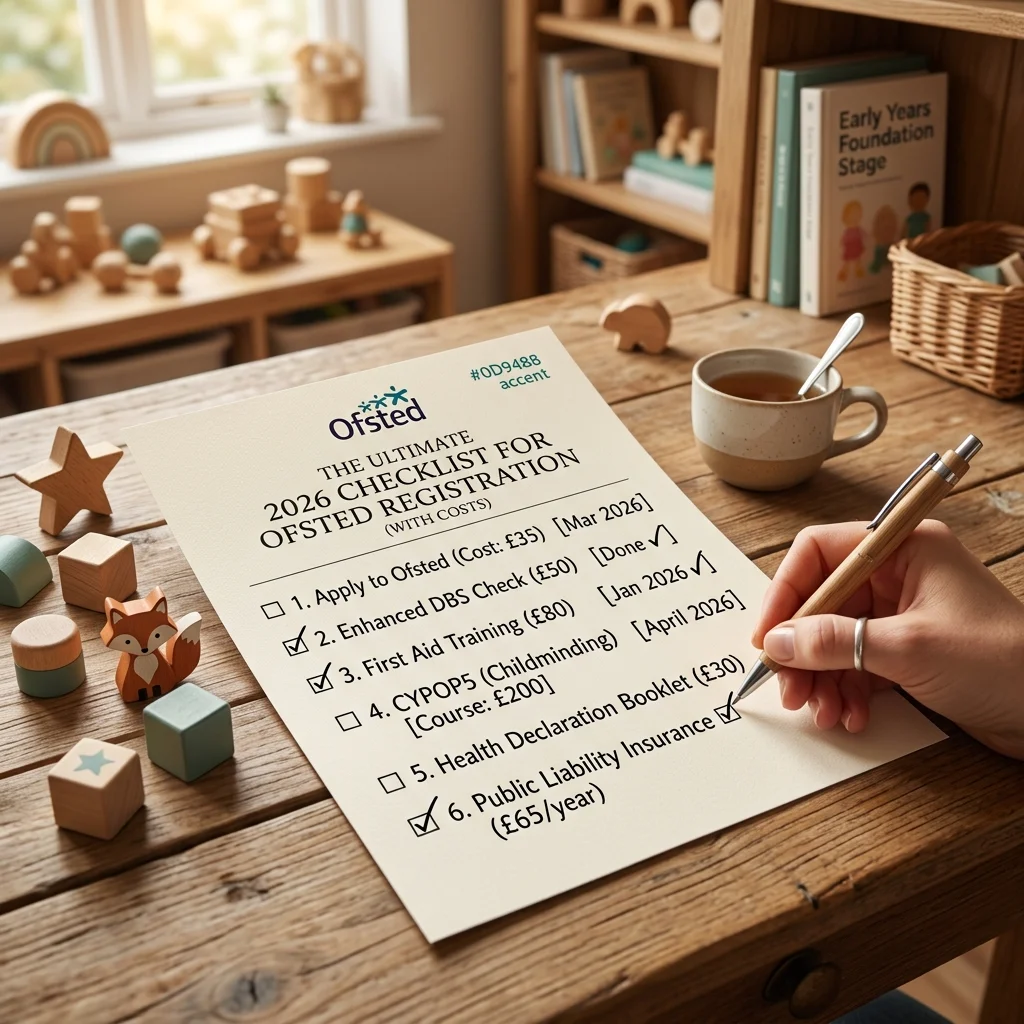
Registering with Ofsted in 2026 requires six sequential compliance stages: household DBS vetting, GP medical clearance, mandatory paediatric and safeguarding training, tenure and property risk assessments, Environmental Health food business registration, and formal portal submission. Completing these stages systematically avoids documentation delays and ensures full readiness for your pre-registration inspection visit.
To avoid the 73% documentation bottleneck and launch within standard Ofsted processing times (typically 10 to 12 weeks), execute this sequential checklist:
- Step 1: Household Vetting & Identity Certification
- Submit Enhanced DBS checks (£52.20) for yourself and all household members aged 16+.
- Set a calendar alert to enroll each certificate in the DBS Update Service (£16.00/year) within 30 calendar days of the issue date.
- Verify identity credentials via the Post Office Document Certification Service or a certified IDSP (£10.00–£15.00).
- Step 2: Medical Fitness Clearance
- Download the official Ofsted Health Declaration Booklet.
- Complete Section A and submit to your GP surgery for Section B completion (£40.00–£120.00).
- Step 3: Statutory Training Certifications
- Complete a 12-hour Paediatric First Aid (PFA) practical and blended course aligned with EYFS para 3.25 (£85.00–£130.00).
- Complete Safeguarding Level 2/3 training approved by your Local Safeguarding Children Partnership (£20.00–£50.00).
- Complete introductory EYFS training (£50.00–£100.00) if uncertified.
- Step 4: Property Clearances, Tenancy & Statutory Policies
- Tenure Approvals: Secure written landlord or freeholder permission if renting or leasehold; notify your mortgage lender and request a business endorsement from your home buildings/contents insurer.
- Environmental Safety & Equipment: Complete a written Home and Garden Risk Assessment, fit smoke alarms on every level, install carbon monoxide detectors, mount window restrictors, and position an accessible fire blanket in the kitchen.
- September 2026 Policy Suite: Draft formal written policies for Safeguarding & Child Protection (with domestic abuse and multi-agency referral pathways), Complaints Procedure, Mobile Phone & Smart Device Usage (EYFS para 3.7), Emergency Evacuation, Health & Safety, and Staff Mental Health Risk Management.
- Step 5: Environmental Health Food Business Registration
- Submit your Food Business Operator registration form to your local council Environmental Health team at least 28 days prior to opening (100% free of charge).
- Implement the FSA Safer Food, Better Business for Childminders pack, including daily fridge temperature logs (< 5°C) and allergen matrices.
- Step 6: Submission, Insurance & Pre-Registration Visit
- Submit your formal Ofsted Early Years Register application via Government Gateway (£35.00).
- Pay your ICO data protection fee (£35.00 via direct debit).
- Secure public liability insurance (£75.00–£100.00, minimum £5m indemnity limit) to commence on your opening date.
- Apply for your £600 DfE Childminder Start-up Grant upon receipt of your Ofsted registration certificate.
- Host your Ofsted Pre-Registration Visit: confidently guide the inspector through your home risk assessments, device security protocols, assistant delegation systems, and observation tracking.
By methodically completing each statutory requirement, you protect your legal standing, recoup your initial outlays, and build an exceptional, compliant childminding business.