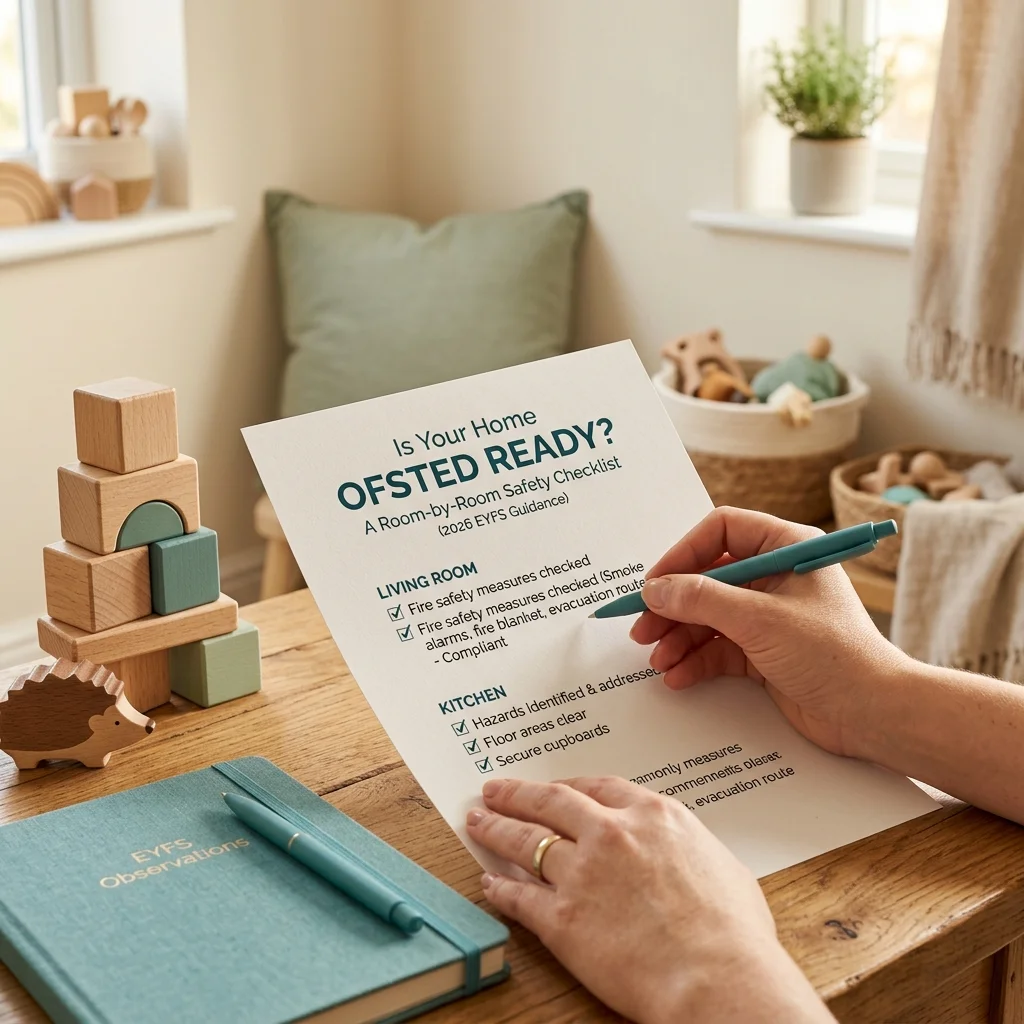
Is Your Home Ofsted Ready? A Room-by-Room Safety Checklist (2026 EYFS Guidance)

KinderStart Early Years Editorial Team
2026-09-15 • 9 min read
Key Takeaways
One of the biggest questions new and established childminders ask is: "Does my house need to look like a commercial day nursery to pass an inspection?"
The answer is an emphatic no—your setting should be a warm, welcoming home. However, it must also be an unequivocally safe learning environment. The EYFS Statutory Framework does not present an exhaustive list of prohibited household objects; instead, under the Childcare Act 2006, it places full legal accountability on the provider to assess risks, eliminate hazards, and maintain a defensible Safeguarding Documentation Guide.
✅Bottom Line Up Front (BLUF)
To pass an Ofsted registration or graded inspection in 2026, UK childminders must prove their domestic setting blends a nurturing home atmosphere with rigorous statutory safety compliance. Under the EYFS framework, providers must verify strict space-per-child usable floor measurements, install certified fire and first aid equipment, ensure keyless emergency escape routes, and maintain continuous digital or written risk assessments across every room.
Whether preparing for an initial registration visit or an unannounced inspection under the Early Years Inspection Handbook, you cannot afford guesswork. Below is our comprehensive, room-by-room statutory checklist covering mandatory equipment, spatial limits, safe sleeping, garden security, food hygiene, and 2026 digital record-keeping mandates.
Key Statutory Takeaways (TL;DR)
- Capacity & Ratios: Strict legal ceiling of six children under eight per adult, with a maximum of three under five and only one under one year old (EYFS paragraphs 3.47–3.48). Direct visual and hearing supervision is mandatory while eating.
- Floor Space Standards: Clear floor area per child must reach at least 3.5 m² for infants under two, 2.5 m² for two-year-olds, and 2.3 m² for children aged three to five (excluding halls, bathrooms, and kitchens).
- Fire Safety Compliance: Corridors must maintain a 1,000 mm escape route width, exit doors must open from inside without a key, and emergency escape windows require a 0.33 m² openable area with sills no higher than 1,100 mm.
- Safe Naptime Environments: Sleeping infants require 3.5 m² clear area, fire-resistant mattresses complying with the Furniture and Furnishings Regulations 1988, dedicated bedding storage, and a hand-washing basin within two metres.
- Food & Environmental Health: Compulsory food business registration with your local council, strict food storage below 5°C, and documented allergen matrices.
- 2026 Digital Mandates: As of 1 April 2026, childminders with combined gross revenue above £50,000 must maintain HMRC-compatible digital records and file quarterly updates under Making Tax Digital (MTD for ITSA).
What Mandatory Safety Equipment Must Childminders Have for Ofsted?
To meet statutory EYFS safety requirements, childminders must maintain functional fire detection systems with interconnected smoke alarms on every level, an accessible fire blanket and extinguisher in food areas, a fully stocked paediatric first aid kit, and safety barriers or childproof safety gates preventing unmonitored access to stairs and kitchens.
Before worrying about continuous provision or play resources, inspectors inspect physical safety infrastructure. If statutory equipment is absent, damaged, or uncertified, an inspector cannot verify that children are adequately protected from harm.
The Non-Negotiable Safety Kit List
- Fire Detection & Fire Fighting Equipment:
- Working, interconnected smoke alarms on every level of the property, tested weekly and logged in your fire safety register.
- A carbon monoxide detector placed in any room containing a fuel-burning appliance or boiler.
- A British Standard-approved fire blanket mounted to the kitchen wall on your primary escape route.
- A suitable domestic fire extinguisher (water mist or foam) maintained in working order.
- Paediatric First Aid (PFA) Kit:
- At least one fully stocked, clearly identifiable first aid kit kept out of reach of children but immediately accessible to adults.
- A secondary compact travel first aid kit for outdoor outings, school runs, and buggy trips.
- All items must remain within their manufacturer expiry dates, with sterile dressings, eye pads, bandages, and hypoallergenic microporous tape.
- Safety Barriers and Enclosures:
- Safety gates conforming to BS EN 1930:2011 installed at the top and bottom of any accessible staircases.
- Physical barriers restricting access to kitchen workspaces while hobs, ovens, or kettles are in use.
- Child safety locks fitted to kitchen cupboards housing sharp knives, cleaning detergents, or glass items.
How Do Childminder Staff-to-Child Ratios and Capacity Limits Operate in 2026?
Under paragraphs 3.47 and 3.48 of the statutory EYFS framework, a childminder may care for a maximum legal ceiling of six children under eight years old. Of those six, no more than three may be under five, and only one may be under one. Practitioners must remain within sight and hearing while children eat.
Understanding how your household members impact capacity is essential. Your own children, any assistants' children, and any other child cared for on the premises under eight count directly towards these statutory ceilings.
| Age Group | Maximum Allowed Ratio (Single Childminder) | Special Conditions & Supervisory Rules |
|---|---|---|
| Infants (Under 1 year) | 1 infant | Only 1 infant permitted at any time unless caring for twins or the childminder's own baby. |
| Early Years (Under 5 years) | Up to 3 children | Includes the single permitted baby under 1. |
| Primary Age (Under 8 years) | Up to 6 children | Inclusive of all younger children and the childminder’s own children under 8. |
| Assistants & Group Ratios | Up to 6 per adult | Maximum ratios duplicate per registered assistant, subject to strict space limitations. |
⚠️Critical Supervision Requirement: Eating and Drinking
Paragraph 3.48 of the EYFS mandates that an adult must remain within sight and hearing of each child while they are eating. Leaving minded children in highchairs or at lunch tables unattended—even for a moment to collect a bib or answer the door—constitutes a serious regulatory breach during an Ofsted inspection.
What Are the Minimum Space-per-Child Usable Floor Area Requirements?
Paragraph 3.82 of the EYFS framework mandates minimum clear, usable indoor floor area per child: 3.5 square metres for infants under two, 2.5 square metres for two-year-olds, and 2.3 square metres for children aged three to five. Measurements strictly exclude hallways, bathrooms, storage cupboards, kitchens, and dedicated staff-only utility rooms.
You must calculate clear, usable space by measuring only the rooms genuinely dedicated to children’s play and learning. When determining your registration capacity, Ofsted inspectors will physically verify room dimensions.
Usable Playroom Clear Area / Statutory Space Standard = Maximum Room Capacity
- Under 2 years old: 3.5 m² per child
- 2-year-old children: 2.5 m² per child
- 3 to 5 years old: 2.3 m² per child
Areas Excluded from Space Calculations
- Entrance Hallways and Porches: Designated circulation paths cannot be classed as play areas.
- Kitchen Work Areas: Because cooking presents thermal and sharp hazards, galley kitchens or preparation spaces are excluded.
- Bathrooms and Nappy-Changing Rooms: Strict hygiene zones are omitted from floor calculations.
- Permanent Built-in Storage: Large fitted wardrobes, immovable sideboards, and heavy domestic furniture reduce the net usable floor area.
Before scheduling your registration inspection, draw a simple floor plan of your property. Record length and width measurements in metres, subtract immovable fixtures, and calculate the maximum number of children your rooms can legally accommodate. Cross-reference this spatial audit with our practical Childminder Risk Assessment Guide.
What Are the Statutory Fire Escape Route, Door, and Window Regulations?
In line with Approved Document B, domestic childminding premises require unobstructed escape routes with a minimum width of 1,000 millimetres, keyless internal exit doors, and visible fire exit signs. Emergency escape windows must provide at least 0.33 square metres of openable area, measuring at least 450 millimetres per side with sills under 1,100 millimetres.
Fire safety in domestic early years settings falls under both the EYFS and the Regulatory Reform (Fire Safety) Order 2005. During an inspection, the inspector will review your escape routes and walk your designated evacuation paths.
Emergency Exit Doors and Hardware
- Keyless Egress: Primary external escape doors (front and back) must feature locks that can be opened from the inside without using a key (e.g., thumb-turn deadbolts). In a smoke-filled room, a childminder must never have to search for a key to evacuate small children.
- Corridor Clearances: Main hallways and stair landings must maintain a minimum clear escape-route width of 1,000 mm (B 2.9 of Approved Document B). Bicycles, pushchairs, and toy storage boxes cannot obstruct corridors.
- Safety Signage: A clearly visible "Fire Exit" sign must be displayed above the primary designated emergency escape door, complying with British fire signage standards.
Escape Windows Specifications
If you use ground-floor or first-floor bedrooms for childcare or infant sleeping, emergency escape windows must meet statutory building regulations:
- Unobstructed Openable Area: At least 0.33 m².
- Minimum Opening Dimensions: Both the height and the width must measure at least 450 mm.
- Sill Height: The bottom edge of the openable window casing must sit no higher than 1,100 mm above the finished floor level, ensuring an adult can exit or evacuate children without climbing onto furniture.
What Are the Statutory EYFS Safe Sleeping and Naptime Room Requirements?
Statutory sleeping provisions require 3.5 square metres of clear floor space per sleeping infant, fire-retardant mattresses meeting the Furniture and Furnishings Regulations 1988, and clean linen stored in dry cupboards. A hand-washing basin must sit within two metres of cots, and audio-visual baby monitors must maintain continuous contact under EYFS paragraph 3.48.
Safe sleep is one of Ofsted’s highest priority inspection targets due to Sudden Infant Death Syndrome (SIDS) prevention protocols. Domestic cots, Moses baskets, and travel cots must be clean, safe, and situated in an optimal environment.
Safe Sleep Checklist
- Space and Furniture Standards:
- Provide a minimum of 3.5 m² of clear floor area per infant cot, calculated after removing any temporary furniture.
- Ensure cots, mattresses, and sleep mats comply with the Furniture and Furnishings (Fire Safety) Regulations 1988 (look for permanent fire-resistance labels; no untreated foam).
- Mattresses must be clean, firm, flat, waterproof, and fit the cot frame tightly with no gaps greater than 20 mm.
- Room Hygiene and Facilities:
- Store individual clean bedding, sheets, and cellular blankets in a clean, ventilated, dry cupboard.
- Provide an accessible hand-washing basin with warm running water within two metres of the nappy changing and cot area to maintain infection control.
- Auditory and Visual Monitoring:
- Position an audio-visual baby monitor so you remain within sight and hearing of every sleeping child at all times (EYFS paragraph 3.48).
- Conduct physical checks every 10 to 15 minutes, documenting chest movements, skin temperature, and sleep position in your daily setting logs.
- Never leave babies unattended on adult beds, sofas, beanbags, or car seats inside the home.
How Must Childminders Secure Outdoor Play Areas and Gardens Under EYFS Rules?
To pass Ofsted outdoor safety evaluations, childminders must ensure children cannot leave premises unsupervised through secure, child-proof perimeter fencing and self-locking high-latch gates. All outdoor play equipment must be age-appropriate and impact-absorbing, toxic garden plants eradicated, and daily outdoor outings planned if a private garden is unavailable on site.
Fresh air and outdoor exploration are core pillars of child physical development. However, outdoor environments present unique physical, environmental, and bio-security hazards.
Garden Safety Controls
- Secure Boundaries: Fences and boundaries must be at least 1.8 metres high with no horizontal footholds that encourage climbing. Check for loose palings, rot, or gaps where a toddler could squeeze through.
- Gate Security: External perimeter gates must be fitted with childproof locking mechanisms or high latches situated at least 1.5 metres above ground level.
- Flora and Plant Hazards: Inspect garden beds for poisonous shrubs or irritant plants (such as Foxglove, Laburnum, Yew, Deadly Nightshade, or Giant Hogweed). Remove them immediately.
- Surface Safety & Play Equipment: Trampolines must have safety enclosures and secure ground anchoring. Climbing equipment over 600 mm high must be placed on impact-absorbing surfaces (such as rubber bark, safety matting, or turf) rather than hard concrete or paving slabs.
- Water Hazards: Ponds must be either safely drained and filled, or protected by heavy-duty steel safety grilles capable of supporting an adult's weight. Water butts must have locked, childproof lids, and paddling pools must be drained immediately after use.
- No Garden Provisions: If your home lacks a private garden, your operational policy must evidence daily planned excursions to local parks, green spaces, or playgrounds, weather permitting.
How Do You Assess Hidden Domestic Hazards Like Low-Level Glass and Blind Cords?
Childminders must eliminate internal household hazards by securing low-level glass with safety film or barriers, fitting British Standard safety cleats to eliminate looped blind cord strangulation hazards, and discarding chipped crockery immediately. Providers must maintain dynamic risk assessments identifying sharp corners, radiator burns, trailing electrical wires, and accessible toxic cleaning chemicals.
Domestic homes are designed for adult convenience rather than active toddler groups. Ofsted inspectors look closely at the "hidden" hazards that can easily be overlooked in your daily routine.
1. Low-Level Architectural Glass and Mirrors
Any interior glazed doors, French windows, glass coffee tables, or low display cabinets situated below 800 mm from floor level pose severe shattering risks. Under building standards:
- Glazing must be toughened safety glass conforming to BS 6206 / BS EN 12600.
- If non-safety glass is present, you must apply certified safety film (minimum 100-micron thickness) or erect physical safety barriers preventing children from falling against it.
2. Blind Cords and Looped Chains
Loose, dangling blind cords represent a lethal strangulation hazard. Under European and British Standards (BS EN 13120):
- Install cord cleats or tensioners at least 1,500 mm above floor level.
- Cords must be trimmed short or fitted with breakaway safety devices so loops cannot form.
- Move cots, highchairs, and climbing play apparatus away from window treatments.
3. Crockery, Radiators, and Electrical Points
- Damaged Items: Thoroughly inspect your kitchen cupboards; chipped bowls, cracked mugs, and crazed plates must be thrown away immediately to prevent lacerations and bacterial accumulation.
- Low-Surface Burns: Central heating radiators should be fitted with thermostatic mixer valves or protective radiator covers to prevent contact burns.
- Electrical Safety: While modern UK 13A electrical sockets (BS 1363) feature internal safety shutters that make conventional plastic socket covers redundant, ensure there are no overloaded extension leads, trailing cables, or accessible plug points near water.
What Kitchen, Food Hygiene, and Allergen Standards Must Childminders Meet?
Childminders providing meals or snacks must register with their local authority environmental health department as a food business under the Food Hygiene (England) Regulations 2006. Settings must maintain hygienic food prep surfaces, separate hand-washing basins, refrigerator operating temperatures below 5 degrees Celsius, documented allergen records, and uninterrupted visual feeding supervision.
Preparing food in your domestic kitchen makes you an official food business operator under the Food Hygiene (England) Regulations 2006 (Regulations 12–13).
Statutory Food Safety Checklist
- Food Business Registration: You must register your setting with your local Environmental Health department at least 28 days before opening or serving food to minded children.
- Temperature Control: Your refrigerator must operate consistently between 0°C and 5°C (legally below 8°C). Keep a calibrated digital thermometer in the main compartment and record daily fridge temperatures.
- Cross-Contamination & Hand Hygiene:
- Install dedicated liquid antibacterial soap and disposable paper towels (or individually allocated, daily laundered hand towels) at the kitchen basin.
- Use colour-coded chopping boards to separate raw meat, poultry, vegetables, and ready-to-eat foods.
- Allergen Management: Under the UK Food Information Regulations, childminders must document ingredients for the 14 statutory allergens (including peanuts, tree nuts, gluten, milk, and eggs) and obtain written medical and dietary declarations from parents upon admission.
- Supervision During Mealtimes: As required by EYFS paragraph 3.48, maintain continuous visual supervision of children while eating, ensuring highchairs are equipped with secure five-point safety harnesses and positioned away from hot appliances.
How Should You Manage Entryways, Visitor Logs, and Setting Risk Assessments?
Ofsted inspection protocol requires childminders to operate keyless, thumb-turn front door exits, complete dedicated entry-area risk assessments mitigating trip hazards like welcome mats, and maintain an immutable visitor log. Every visiting adult's identity, arrival time, departure time, and business purpose must be recorded and presented to inspectors upon request.
The entrance to your home is the first area the inspector will see. It sets the tone for your safeguarding, fire security, and daily operational vigilance.
Visitor Enters Setting ➔ Identity & DBS Checked ➔ Logged in Visitor Book ➔ Accompanied at All Times
Hallway & Reception Safety Essentials
- Secure Entry & Access Control:
- The front door must be securely locked to prevent unauthorised external entry and to stop adventurous toddlers from wandering out.
- Emergency egress must remain completely unhindered: use thumb-turn cylinder deadbolts rather than keyed locks on the inside.
- Visitor Identity Verification:
- Maintain a digital or hardcopy visitor register. Any visiting delivery drivers, tradespersons, prospective parents, or family friends entering during operating hours must be logged with their full name, organisation, arrival time, departure time, and reason for visit.
- Visitors must never be left unsupervised with minded children under any circumstances unless they have undergone a registered DBS check and suitability assessment.
- Entryway Risk Assessment:
- Keep hallways clear of pushchairs, coats, and scattered shoes.
- Secure welcome mats with non-slip backing to prevent tripping incidents during drop-off and pick-up transitions.
What Are the Making Tax Digital (MTD) Record-Keeping Mandates for Childminders in 2026?
Starting 1 April 2026, self-employed childminders with gross business and property revenue exceeding £50,000 must comply with Making Tax Digital for Income Tax Self Assessment (MTD for ITSA). Practitioners must maintain digital bookkeeping using HMRC-approved software, file quarterly summaries of income and expenses, and submit an annual finalisation declaration.
Under the Income Tax (Digital Obligations) Regulations 2026 (SI 2026/336), the traditional paper cashbook or retrospective annual self-assessment return is no longer sufficient for high-earning sole traders and group-operating childminders.
Understanding Your 2026 MTD Obligations
- Gross Income Threshold (£50,000): If your total gross income from childcare fees, government funding entitlements, and any auxiliary self-employment or property rental exceeds £50,000 in the 2024/2025 tax year, MTD mandates apply from 1 April 2026. (Providers earning between £30,000 and £50,000 will join the regime from April 2027).
- Digital Record-Keeping: You must maintain digital records of all business transactions, invoice receipts, food deductions, and operational expenses in HMRC-compatible digital tools.
- Quarterly Submission Cadence: Childminders must file quarterly business updates directly to HMRC within one month of each quarter-end:
- Quarter 1: 6 April – 5 July (Due 5 August)
- Quarter 2: 6 July – 5 October (Due 5 November)
- Quarter 3: 6 October – 5 January (Due 5 February)
- Quarter 4: 6 January – 5 April (Due 5 May)
- Final Declaration: Submit a single end-of-year declaration by 31 January following the tax year, reconciling personal allowances, capital allowances, and final tax liabilities.
Integrating your daily attendance registers, contract fees, and financial accounts into a dedicated digital childminder operating system ensures you meet HMRC requirements while keeping your setting organised and inspection-ready.
Complete Room-by-Room Ofsted Safety Checklist
Use this structured room-by-room audit table to review your home before your Ofsted inspection:
| Room / Area | Hazard / Item to Inspect | Statutory Standard / Action Required | Verified? |
|---|---|---|---|
| Entrance & Porch | Front door locks & mats | Thumb-turn lock on inside; non-slip welcome mat; visitor log accessible. | [ ] |
| Hallways & Stairs | Escape route & stairs | Minimum 1,000 mm clear width; safety gates conforming to BS EN 1930 at top and bottom. | [ ] |
| Kitchen | Food prep, chemicals, knives | Local authority food registration; fridge under 5°C; knives & chemicals locked away; fire blanket wall-mounted. | [ ] |
| Living Room / Playroom | Furniture, glass, cords | Blind cords fitted with cleats at 1,500 mm; safety film on glass below 800 mm; radiators covered; clear space verified. | [ ] |
| Nap & Sleeping Room | Cots, bedding, monitors | 3.5 m² space per infant; mattresses BS fire-labelled; hand basin within 2 m; baby monitor in sight and hearing. | [ ] |
| Bathroom & Changing | Water temp, toiletries | Thermostatic mixer valve on taps (max 43°C); individual towels or paper roll; soaps/medicines locked away. | [ ] |
| Garden & Outdoors | Fencing, plants, gates | 1.8 m secure perimeter; high-latch self-closing gate (1.5 m); water butts locked; poisonous plants removed. | [ ] |
| Office & Admin | Fire log, MTD records | Recorded fire evacuation drills; parental permissions; paediatric first aid cert; HMRC-ready digital records. | [ ] |
💡Eliminate Paperwork Stress With KinderStart
Streamline Your Statutory Compliance & Progress Tracking
Preparing your home for an inspection is only half the battle; documenting children's developmental journeys and managing your statutory records is the other.
- Statutory Framework Alignment: Tag daily observations directly to statutory learning goals and generate two-year progress checks without tick-box paperwork.
- Secure Inspection Evidence: Log attendance, emergency drills, risk assessments, and daily sleep checks in a single intuitive system.
- Save Hours Every Week: Spend less time on administrative paperwork and more time engaging with minded children.
Explore EYFS Curriculum & Progress Reports | Download KinderStart Today
Frequently Asked Questions
What are the legal childminder staff-to-child ratios under the EYFS in 2026?
Under EYFS paragraphs 3.47 and 3.48, a childminder may look after a maximum legal ceiling of six children under the age of eight. Within this six-child limit, no more than three children may be under the age of five, and only one may be an infant under one year old. Practitioners must remain within direct sight and hearing of all children while they are eating.
What is the minimum clear floor space required per child in a childminding setting?
According to EYFS paragraph 3.82, childminders must provide a minimum clear, usable indoor floor area of 3.5 m² for each infant under two years old, 2.5 m² for each two-year-old child, and 2.3 m² for children aged three to five years. Clear floor space calculations strictly exclude hallways, storage cupboards, bathrooms, kitchens, and dedicated staff-only utility rooms.
What are the fire escape window and door requirements for childminder homes?
In compliance with Approved Document B and building safety guidance, domestic escape routes must maintain a minimum clear width of 1,000 mm, and exit doors must open from the inside without a key using thumb-turn locks. Emergency escape windows must provide an unobstructed openable area of at least 0.33 m², with minimum dimensions of 450 mm in height and width, and a sill height no higher than 1,100 mm from the floor.
What are the safe sleep regulations for babies in a home early years setting?
Childminders must provide at least 3.5 m² of clear floor area per sleeping infant. Cots and mattresses must comply with the Furniture and Furnishings (Fire Safety) Regulations 1988 with permanent fire-resistance labels. Clean bedding must be stored in dry cupboards, hand-washing facilities must be within two metres of cots, and audio-visual baby monitors must ensure children remain within sight or hearing at all times under EYFS paragraph 3.48.
Do childminders need to register as a food business and follow Making Tax Digital in 2026?
Yes. Under Regulation 12 of the Food Hygiene (England) Regulations 2006, childminders who provide meals, drinks, or snacks must register their home with their local authority environmental health department. Furthermore, from 1 April 2026, childminders whose gross annual income from childminding and other self-employment or property exceeds £50,000 must maintain digital accounting records and submit quarterly updates under HMRC Making Tax Digital (MTD for ITSA) regulations.