Safe Sleep for Childminders: EYFS Rules
Daniel Broadhurst (Founder)
2026-11-23 • 7 min read
Key Takeaways
 Key Takeaways
Nap time is when the house goes quiet and you finally get to wipe the table. It's also when the EYFS asks you to be most careful. From 1 September 2026, the EYFS statutory framework for childminders gives much more detail on safe sleep. The EYFS is the set of rules for early years care in England. The new rules cover babies and children under 2.
This guide sets out what the EYFS says and what the NHS and the Lullaby Trust advise. Then it turns it into a simple routine for a busy day.
This is for childminders in England. Scotland and Wales have their own care standards: see childminding in Scotland and childminding in Wales. The NHS and Lullaby Trust advice below applies to babies wherever you work.
✅The short version
- Under 2s sleep on their back, in their own sleep space, on a firm, flat surface.
- Babies aged 12 months and under sleep only in a cot. That includes carrycots, Moses baskets and travel cots.
- Nothing else in the cot: no toys, pillows, bumpers, wedges or extra blankets.
- Keep the room at 16 to 20°C and never cover a child's head.
- Babies under 6 months have an adult in the same room for every sleep.
- Sleeping children are within sight and hearing and checked frequently.
What the EYFS says about sleep
Paragraph 3.86 of the EYFS starts with a rule for every child: babies and children must be put down to sleep safely. For children under 2, it then lists these requirements:
- On their back, in their own space. Put each child down on their back in their own sleep space. Use a firm flat surface, such as a cot, bed or mattress on the floor.
- Cots for babies. Babies aged 12 months and under must only be put to sleep in a cot. The EYFS says "cot" means cots, carrycots, Moses baskets and travel cots.
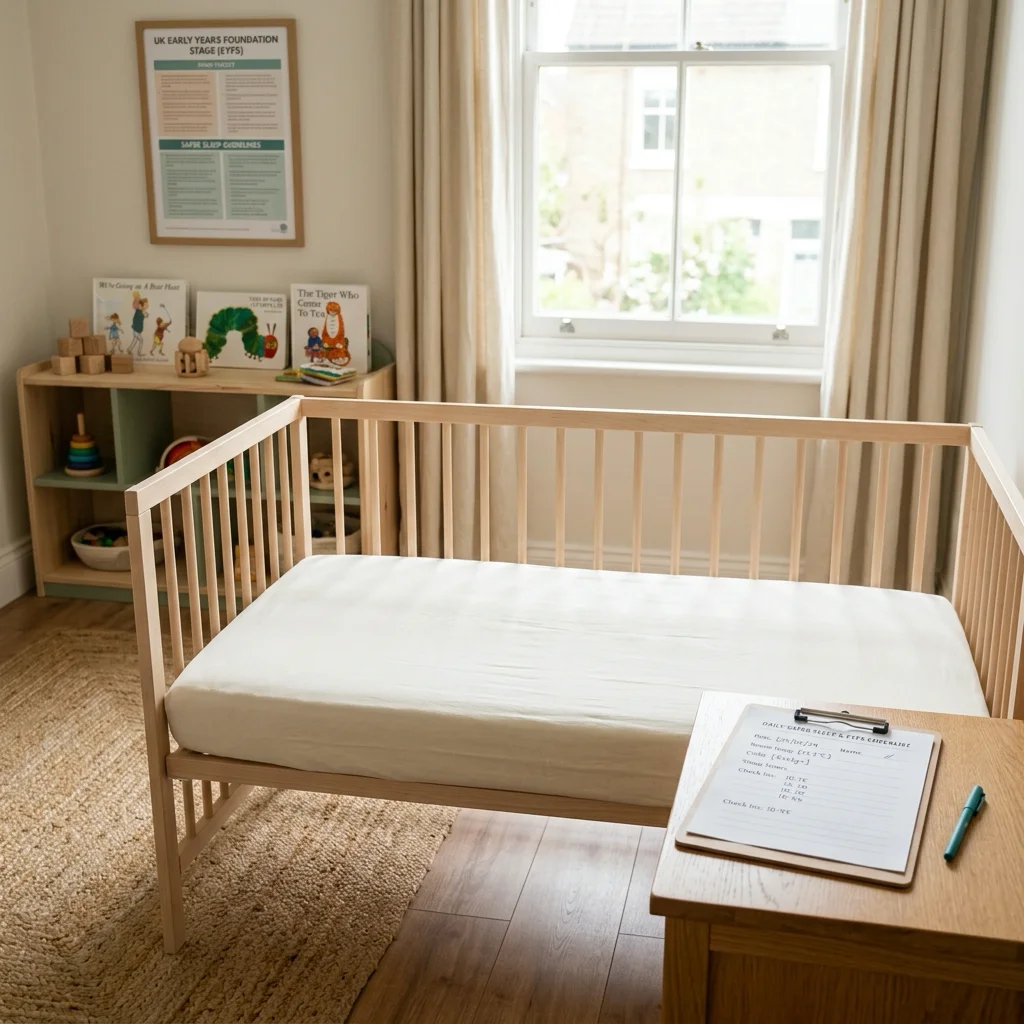
- A clear sleep space. Only a firm, flat, waterproof mattress and lightweight bedding. Tuck the bedding in below the child's shoulders, so it can't cover their head. A well-fitted baby sleep bag is fine instead. Check the maker's guidance first.
- Feet to foot. If you use blankets, put the child's feet at the foot of the cot. Then tuck the blankets in.
- Nothing extra. No toys, pillows, extra blankets, bumpers, wedges or straps in the cot.
- Not too hot or cold. The recommended room temperature for babies is 16 to 20°C.
- Heads uncovered. A child's head must never be covered.
- An adult in the room for young babies. Babies under 6 months must have an adult in the same room for every sleep.
- Frequent checks. All sleeping children must be checked frequently.
- Sight and hearing. Children must always be within sight and hearing when they're asleep.
The EYFS also says you must read the NHS advice on sudden infant death syndrome (SIDS). It points you to the Lullaby Trust for more on safer sleep.
How often should I check sleeping children?
 How often should I check sleeping children?
The EYFS says "frequently" but doesn't give a number of minutes. Decide how often you check, based on the children's ages and needs. Write it in your sleep or safeguarding policy, and stick to it. What matters is that you can show you did it.
What the NHS advises
The NHS SIDS page, which the EYFS tells you to read, says:
Do
- Put babies on their back to sleep, in the feet-to-foot position.
- If a baby rolls onto their tummy, turn them onto their back until they can roll both ways on their own.
- Use a firm, flat mattress.
- Keep the cot clear of anything that could cover their face or head, including pillows, duvets, bumpers, loose blankets, soft toys, pods and nests.
- Keep the room at around 16 to 20°C, and take off a layer if the baby feels hot or sweaty.
Don't
- Don't let a baby sleep on a sofa or in an armchair with you.
- Don't smoke near a baby, or let anyone smoke in the room.
- Don't let a baby get too hot or too cold.
- Don't leave a baby in a car seat for longer than needed. Take them out once you arrive.
- Don't use hot water bottles or electric blankets, or put a baby near a radiator, heater, fire or direct sunlight.
That car seat point matters on school runs. If a baby drops off in the car, move them to their cot when you get home. Don't leave them in the seat.
What the Lullaby Trust adds
The Lullaby Trust's safer sleep advice matches the NHS and adds one point that's useful in childcare: follow the advice for every sleep, day and night, until a baby is 12 months old. For babies born early, that's 12 months from their due date. Doing something different from usual can be unsafe, so keep naps the same each time.
It also has a safer sleep in childcare checklist for families. It's written for parents choosing childcare, so it's worth reading to know what families may ask you.
When a parent's routine at home is different
Some families settle their baby differently at home: on their front, with a cot bumper, with a muslin, in a pod or nest. The EYFS rules are requirements, so you have to follow them whatever happens at home. Talk it through before the child starts. Explain that the rules come from the EYFS and the NHS. Then agree a safe way to help the baby settle.
Write the child's usual routine down when they start: when they nap, how long, how they like to be settled, and any comforter. Our free sleep routine form, part of the printable below, gives you a page for this.
Keeping a sleep check record
The EYFS doesn't prescribe a form for sleep checks. A simple record helps you keep to your routine. It gives parents a clear picture at home time, and shows an inspector what you do.
Our free sleep check record has room for up to 6 children a page. It records check times, position, breathing and room temperature. There's also a sleep routine form for parents.
If you use KinderStart's childminding app, you can start a nap and log each check on your phone. Choose how the child is lying and whether they're breathing normally. Nothing is filled in for you, so a check is only saved once you've actually looked.
Your sleep set-up checklist
Before the first nap of the day:
- Every child under 2 has their own cot, travel cot or mattress, and babies 12 months and under are in a cot.
- Mattresses are firm, flat and waterproof.
- Cots are empty apart from tucked-in lightweight bedding or a well-fitted sleep bag.
- The room is between 16 and 20°C.
- Cots are away from radiators, heaters and direct sunlight.
- You can see and hear every sleeping child.
- A baby under 6 months has an adult in the same room.
- Your sleep check record is ready.
For the rest of your home, see our room-by-room Ofsted ready checklist. For what an inspector looks at overall, see our guide to Ofsted inspection for childminders.
 Try Our Free Tools