Childminder Finance & Tax 2026: MTD Expense Rules and the New EYFS Statutory Guidance
Daniel Broadhurst (Founder)
Sep 15, 2026 • 9 min read
Key Takeaways
If you are a registered childminder in England, two separate pieces of statutory change have landed on your desk this year, and they interact in a way that is easy to miss. HMRC has withdrawn the childminder-specific expense concessions for anyone inside Making Tax Digital from April 2026, and the Department for Education's revised EYFS statutory framework took effect on 1 September 2026. One changes how you calculate your profit; the other changes what you have to be able to prove.
For the full cluster context on what you can and cannot deduct, start with our Childminder Allowable Expenses Guide — this post covers what specifically changed in 2026 and what to do about it before your next quarterly update.
✅Bottom Line Up Front (BLUF)
From April 2026, childminders who fall within Making Tax Digital for Income Tax can no longer use HMRC's childminder-only simplified methods — the flat-rate percentage for household costs, the food allowance, and the 10% wear and tear deduction. You must calculate actual costs and apportion them on a just and reasonable basis, keeping digital records throughout. Separately, the EYFS statutory framework effective 1 September 2026 adds safeguarding and welfare record-keeping duties that sit directly alongside those financial records.
TL;DR
- Concessions withdrawn for MTD childminders: HMRC's Business Income Manual (BIM52751) states that from April 2026 the childminder-specific alternative methods do not apply to childminders within MTD.
- You now follow ordinary business rules: Actual costs, apportioned justly and reasonably — or the standard simplified expenses regime available to every sole trader.
- Still outside MTD? Nothing changes yet: Below the £50,000 qualifying income threshold, the old childminder methods remain available until you are mandated in.
- Threshold steps down: £50,000 from April 2026, £30,000 from April 2027, with £20,000 announced for April 2028 — so plan for the transition rather than waiting for the letter.
- Quarterly rhythm: Four updates a year (7 August, 7 November, 7 February, 7 May) plus a final declaration each 31 January.
- EYFS from 1 September 2026: Stronger safeguarding duties and new requirements on safer sleeping, eating and weaning — all of which generate dated records you must retain.
- One set of records, two audiences: Attendance, invoices and expense receipts serve both HMRC and Ofsted. Keeping them digitally in one place is now the practical minimum.
What changes for childminder finance and tax in 2026?
Two statutory changes land together. From April 2026, childminders inside Making Tax Digital for Income Tax lose HMRC's childminder-only simplified expense rates and must follow ordinary business rules. From 1 September 2026, the revised EYFS statutory framework adds record-keeping duties that feed directly into those digital accounts.
These are not related policies, but they arrive in the same tax year and they compound. The tax change increases the precision required in your bookkeeping — you can no longer reach for a percentage table. The EYFS change increases the volume of dated evidence you must hold. A childminder who was previously managing on a paper cashbook and an annual reconciliation now has four filing deadlines a year and a framework that expects contemporaneous welfare records.
The good news is that both pull in the same direction. The attendance register that evidences your ratios is also the audit trail behind your invoices. Sorting one out sorts out a good deal of the other.
Do childminders still get HMRC's simplified expense rates under Making Tax Digital?
No. HMRC's Business Income Manual confirms that from April 2026 the childminder-specific methods — flat-rate household percentages, the food allowance and the 10% wear and tear deduction — no longer apply to childminders within MTD. You must follow the normal expense and record-keeping rules that apply to every other business.
For decades, childminders enjoyed a pragmatic concession negotiated between HMRC and the childminding associations. Rather than measuring rooms and metering electricity, you could claim a flat percentage of your household bills based on the hours you minded each week:
| Hours minded per week | Proportion of household costs claimable |
|---|---|
| 10 hours | 8% |
| 15 hours | 12% |
| 20 hours | 17% |
| 25 hours | 21% |
| 30 hours | 25% |
| 35 hours | 29% |
| 40 hours | 33% |
Alongside this sat a food and drink allowance and a wear and tear deduction of 10% of your total childminding income to cover the depreciation of furnishings and equipment. Check BIM52751 for the exact banding that applies to your hours if you are still outside MTD.
The manual is now explicit: "From April 2026 this guidance does not apply to childminders within MTD. Childminders within MTD should follow the rules for expenses and record-keeping that apply to all other businesses, and not use the alternative methods detailed below."
Who this affects right now. Only childminders who have been mandated into MTD. That means qualifying income above £50,000 for 2026/27. If you are below that line, the table above is still yours to use — but the threshold falls to £30,000 from April 2027, and a further step to £20,000 has been announced for April 2028. Most working childminders will be inside the regime within two years. Our MTD for Childminders 2026 Guide walks through how to check which band you fall into.
The practical consequence. For many childminders the flat rates were generous relative to actual apportioned costs, particularly on food. Recalculate before you assume your tax bill is unchanged — some practitioners will find their allowable expenses fall, and the payment on account that follows is best anticipated rather than discovered in January. Our breakdown of the wear and tear allowance changes covers how to handle equipment now that the 10% shortcut has gone.
How do you calculate use of home expenses once the flat rates stop applying?
Apportion actual household costs on a just and reasonable basis. Measure the rooms used for childminding, the hours you mind each week, and apply that fraction to rent, mortgage interest, council tax, utilities and insurance. Alternatively, use HMRC's standard simplified flat rate for working from home.
There are two legitimate routes, and you should model both before choosing.
Route 1 — Actual cost apportionment. This is the method every other home-based business uses. It requires two fractions:
- A space fraction. Count the rooms in your home, excluding hallways, bathrooms and any room never used for childminding. If you use three of eight qualifying rooms, your space fraction is 3/8.
- A time fraction. Divide the hours those rooms are used for childminding by the total hours they are available for use. A playroom used 45 hours a week out of an available 105 waking hours gives roughly 43%.
Multiply the two fractions together and apply the result to each household bill. Keep the calculation written down — HMRC's test is whether your apportionment is just and reasonable, and a documented method is far easier to defend than a remembered one. Our step-by-step worked example lives in How to Calculate Use of Home Expenses as a Childminder.
Route 2 — Standard simplified expenses. HMRC's general flat rate for working from home is available to all sole traders and is banded by the number of hours worked from home each month. It is far less generous than the old childminder rates, but it is quick and requires no measurement. If your household bills are modest, it may still come out ahead once you value your own time.
Costs that are unaffected. Direct business costs never relied on the concession and remain fully deductible: Ofsted registration fees, public liability insurance, ICO registration, professional association membership, DBS checks, first aid and safeguarding training, toys and resources, and mileage at the approved rates of 45p per mile for the first 10,000 business miles and 25p thereafter. Food purchased specifically for minded children is still allowable — you simply now claim the actual cost rather than an agreed allowance, which means keeping the receipts and splitting the weekly shop.
For the full picture of what falls the wrong side of the line, see our Childminder Disallowable Expenses List.
What records does the September 2026 EYFS statutory framework require childminders to keep?
The framework effective 1 September 2026 strengthens safeguarding duties and introduces requirements covering safer sleeping, eating and weaning. Practically, that means dated records of sleep checks, allergy and weaning plans, attendance, incidents and staff suitability checks — many of which double as the evidence behind your invoices and expense claims.
The EYFS statutory framework for childminders was dated 13 July 2026 and came into force on 1 September 2026. The full childminder edition PDF is the authoritative text — the DfE has confirmed the requirements have not changed since the July publication, so there is no second version to wait for.
Compliance is not optional guidance. It is a condition of your registration under the Childcare Act 2006, enforceable by Ofsted or your Childminder Agency. Our detailed walkthrough of the welfare changes is in New EYFS Statutory Framework (September 2026).
The headline themes for record-keeping:
- Safeguarding and child protection. A stronger emphasis across all settings, with clearer expectations on training currency and on documenting concerns as they arise rather than retrospectively. The DfE has published an online safeguarding training package alongside the framework.
- Safer sleeping. Sleep environments and check intervals now sit within the statutory welfare requirements. Logged, timed checks are the evidence.
- Eating and weaning. New requirements reflecting current guidance on keeping babies and very young children safe during feeding and the introduction of solids. Expect to hold individual weaning plans and allergy information per child.
- Suitability evidence. Enhanced checks for anyone working with or living alongside the children in your care, with the certificates retained and dated.
Where this meets your tax records. Three documents serve both masters simultaneously. Your attendance register proves your ratios to Ofsted and substantiates the hours on every invoice. Your food and menu records evidence weaning and allergy compliance and support the actual-cost food claim that replaced the old allowance. Your contract and fee schedule evidences the funded hours you have committed to and is the source document for income you now report quarterly. Keeping them in three different places is how childminders end up doing the same work twice.
When must childminders send MTD quarterly updates in 2026/27?
If your qualifying income exceeded £50,000 in the 2024/25 tax year, your first MTD quarter began on 6 April 2026. Quarterly updates are due by 7 August, 7 November, 7 February and 7 May, followed by your final declaration on 31 January 2028.
The rhythm is unforgiving but predictable:
| Quarter | Period covered | Update deadline |
|---|---|---|
| Q1 | 6 April – 5 July 2026 | 7 August 2026 |
| Q2 | 6 July – 5 October 2026 | 7 November 2026 |
| Q3 | 6 October 2026 – 5 January 2027 | 7 February 2027 |
| Q4 | 6 January – 5 April 2027 | 7 May 2027 |
| Final declaration | Full 2026/27 tax year | 31 January 2028 |
Each update is a cumulative summary of income and expenses by category, submitted from MTD-compatible software through HMRC's API. Spreadsheets alone will not do it — you need either bridging software or a system that files directly, and the connection between your records and your submission must be a digital link rather than a retyped figure. We cover the detail in MTD Quarterly Reporting for Childminders and, if you are currently on a spreadsheet, in Is Excel MTD Compliant? Digital Links Explained.
A quarterly update is not a tax calculation. You are not paying anything at these points and you can correct earlier figures in a later submission — the final declaration is where the liability crystallises. That said, four chances a year to notice a mistake is considerably better than one.
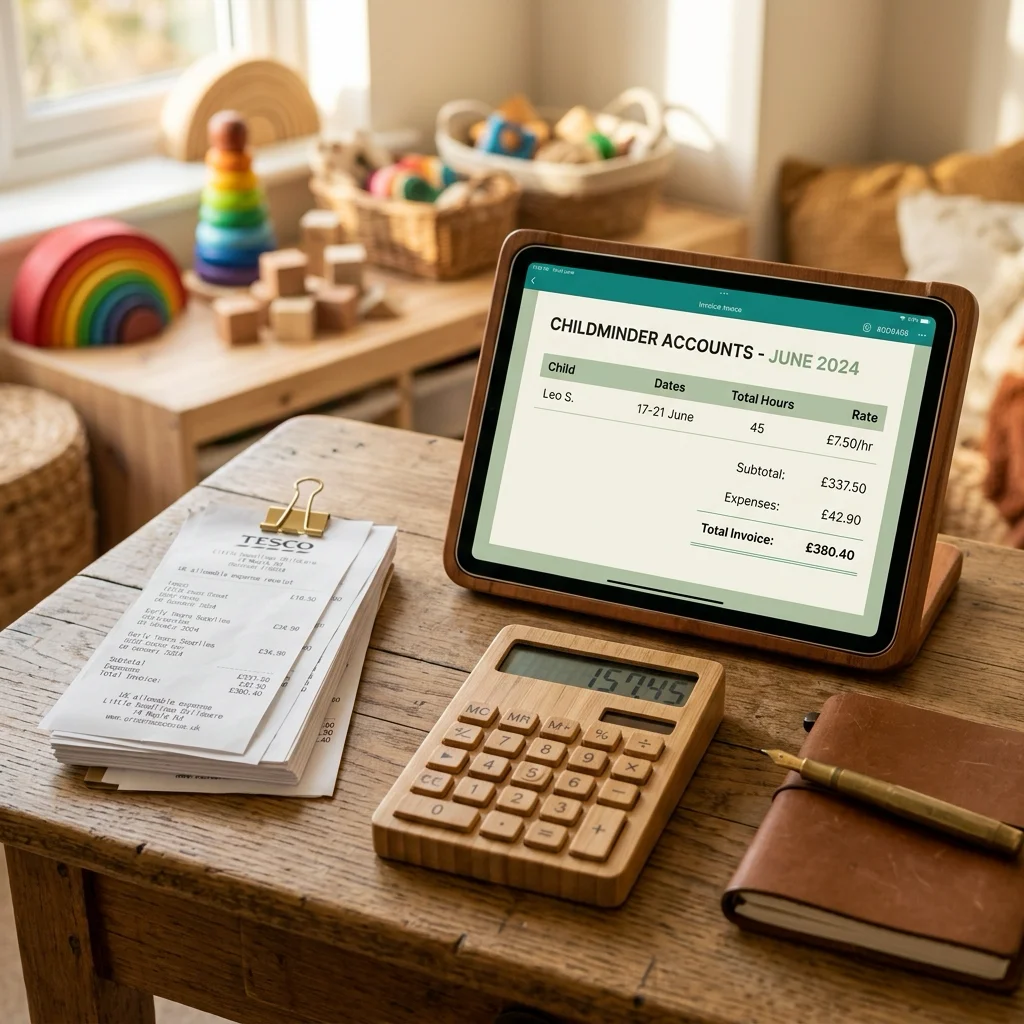
💷 MTD-Compliant Invoicing & Expenses for Childminders
Automate parent invoices, calculate allowable business expenses, and stay 100% compliant with HMRC Making Tax Digital rules — with your attendance records and your accounts in one place.
How should childminders prepare for the new finance rules before April 2027?
Start by recalculating your use-of-home and food claims on an actual-cost basis, then keep every receipt digitally from the start of the tax year. Move to MTD-compatible software now, reconcile invoices weekly, and align your EYFS attendance records with the income you report.
A practical order of work, whether you are mandated now or in April 2027:
- Run the comparison. Take last year's figures and recalculate your use-of-home claim using the space-and-time apportionment above. Compare it with what the flat rate gave you. If the number falls materially, you know your likely tax position before it becomes a surprise.
- Write down your method. One page: rooms counted, hours used, the resulting fraction, and the bills it is applied to. Date it. Review it whenever your pattern of work changes.
- Go digital from a clean start date. Mid-year migrations create reconciliation gaps. The start of a tax year or a quarter is the natural cut.
- Photograph receipts at the point of purchase. The actual-cost regime is only as strong as your evidence. A receipt captured in the car park is a receipt you still have in January.
- Separate the shop. Food for minded children is allowable at actual cost; food for your family is not. Split at the till or annotate the receipt — retrospective estimation is exactly what "just and reasonable" is not.
- Reconcile invoices against attendance weekly. Under-invoiced hours are the most common source of lost childminder income, and the EYFS attendance record you are already keeping is the check.
- Diarise the four dates. 7 August, 7 November, 7 February, 7 May. Put them in the same calendar as your policy review dates and your DBS renewals.
If you work with an accountant, the conversation to have now is whether they are set up to file MTD quarterly updates for a home-based sole trader, and what they need from you each quarter to do it without chasing.
Remain 100% Compliant with KinderStart
The 2026 changes ask more of your record-keeping in two directions at once: more precision for HMRC, more evidence for Ofsted. KinderStart is built specifically for independent UK childminders, so the same attendance record that proves your ratios also sits behind the invoice you issue and the quarterly figure you file.
Automated parent invoicing, allowable expense tracking, MTD-ready records and EYFS-aligned daily logs — one system, audit-ready every day.
Ready to simplify your childminding business? Explore KinderStart's MTD invoicing and expenses tools or download the app on iOS and Android.
This article is general guidance for UK childminders and is not personal tax advice. Statutory thresholds and HMRC guidance change — always check GOV.UK or speak to a qualified accountant about your own circumstances. Last reviewed: 15 September 2026.
Related statutory reading:
-
Navigating Funded Hours and Tax-Free Childcare: A Childminder's Guide (2026)
-
The Ultimate UK Childminder Pay Guide (2026): Salary, Rates & Funding
Related statutory reading:
Related statutory reading:
Related statutory reading:
Related statutory reading:
Related statutory reading:
Related statutory reading: