Never Build a Spreadsheet Again: Inside the KinderStart Finance Engine (Childminder Finance & Tax 2026)
KinderStart Team
2026-10-06 • 7 min read
Key Takeaways
 Key Takeaways
Never Build a Spreadsheet Again: Inside the KinderStart Finance Engine (Childminder Finance & Tax 2026)
Let's talk about the part of childminding everyone dreads: the Friday night reconciliation session. Scraps of paper with late pick-up times, a half-filled spreadsheet for milk money, and the nagging feeling that you've undercharged for a funded place.
Childminder finances are genuinely complex. Between 15 and 30-hour funding, stretched hours over the summer, consumable charges and now Making Tax Digital, it is easy to feel overwhelmed. This guide shows how the KinderStart Finance Engine handles it, and sits alongside our Allowable Expenses Guide, which explains exactly what you can claim.
✅Bottom Line Up Front (BLUF)
Making Tax Digital for Income Tax has applied since 6 April 2026 to self-employed people with qualifying income above £50,000, and the threshold falls in 2027 and 2028. A standalone spreadsheet cannot send HMRC your quarterly updates, so childminders need digital records that flow into compatible software. KinderStart turns your attendance register into invoices, expense records and a live tax projection in one place.
TL;DR
- MTD for Income Tax started on 6 April 2026 for qualifying income over £50,000, then £30,000 from April 2027 and £20,000 from April 2028.
- Quarterly updates are due by 7 Aug, 7 Nov, 7 Feb and 7 May, with a final declaration by 31 January.
- Spreadsheets only work with compatible bridging software; manual re-typing between programmes breaks the digital link.
- HMRC does not mandate any specific childminder software, so check any "MTD compliant" claim against HMRC's own list.
- Your attendance register drives invoices, funded-hours calculations and wraparound charges.
- Log receipts as you spend, and keep tax records for at least five years after the 31 January deadline.
- Childminder ratios are up to six children under eight, no more than three of them young children (not yet in Reception year).
What is the KinderStart Finance Engine and how does it replace a spreadsheet?
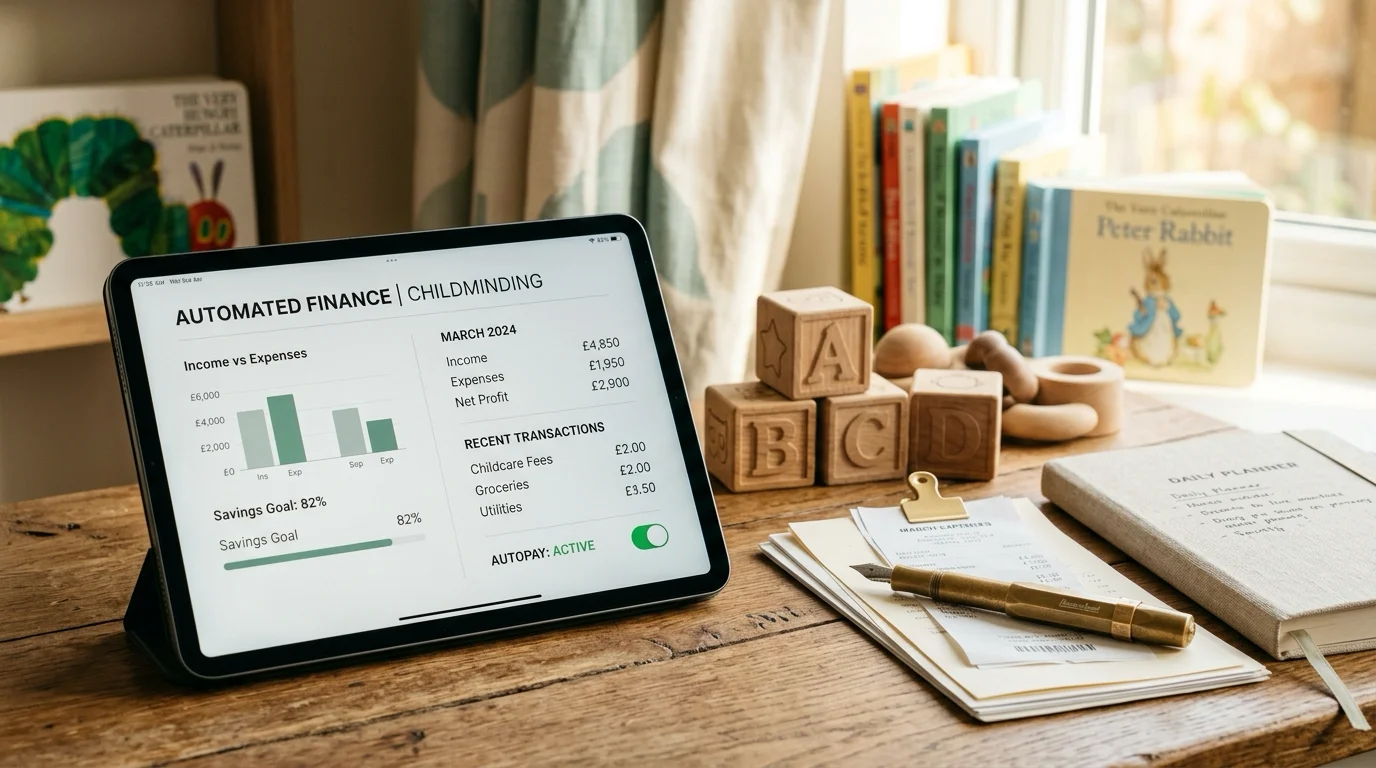
The KinderStart Finance Engine is the part of the app that turns your attendance register into invoices, tracks allowable expenses and shows a live tax projection. Instead of reconciling scraps of paper and spreadsheets each Friday night, you record attendance once and the app calculates the rest from that single source of truth.
It was built specifically for how UK childminders work, rather than adapted from general bookkeeping tools. Read more on the MTD-Compliant Invoicing & Expenses feature page, or browse more technology articles.
Is Making Tax Digital mandatory for childminders in 2026?
Yes, if your qualifying income exceeds £50,000. Making Tax Digital for Income Tax started on 6 April 2026 for self-employed people above that threshold, falling to £30,000 from April 2027 and £20,000 from April 2028. You then keep digital records and send HMRC quarterly updates plus a final declaration.
Qualifying income is your gross self-employment (and property) income, not your profit. Many childminders sit below £50,000 today but will be caught by the lower thresholds, so building digital habits now is far easier than switching under deadline pressure. HMRC sets out the rules in its Making Tax Digital for Income Tax guidance. Our MTD for Childminders Guide walks through sign-up.
| Tax year start | Qualifying income threshold |
|---|---|
| 6 April 2026 | Over £50,000 |
| 6 April 2027 | Over £30,000 |
| 6 April 2028 | Over £20,000 |
Do spreadsheets meet the MTD digital link rules?
Not on their own. HMRC allows spreadsheets only when paired with compatible bridging software that sends data to HMRC, because manual copying or re-typing between programs breaks the digital link. Records must be held digitally and quarterly updates submitted through HMRC-recognised software using its API, so a standalone spreadsheet cannot file anything.
⚠️Check any 'MTD compliant' claim
HMRC has not named a mandatory childminder finance product. Any software you use to submit must authenticate with HMRC and keep an audit trail of transactions. Check HMRC's list of compatible software before you commit, and confirm how your chosen tool submits updates.
How does attendance turn into an invoice automatically?
Your attendance register is the single source of truth. When you tap a child in and out, KinderStart calculates exact hours, including wraparound care outside funded entitlement, and one button generates a professional PDF invoice for parents at month end. That removes manual re-entry, the biggest source of invoicing errors.
Attendance is recorded as it happens.
Funded and chargeable hours are separated.
A PDF invoice is ready for parents.
How do I track allowable expenses without a shoebox of receipts?
Log each expense when you spend it: snap a photo of the receipt in KinderStart and categorise it as an allowable expense. Costs must be wholly and exclusively for your childminding business, so food, toys, equipment and insurance usually qualify, while personal spending does not. Contemporaneous logging gives HMRC-ready records and an accurate live tax projection.
The dashboard shows a live projection of your tax and National Insurance as you earn, so there are no surprises in January. Some costs, such as use of home, need apportioning; see the Allowable Expenses Guide for the detail.
How does the finance engine handle 15 and 30-hour funding?
KinderStart applies the latest 2026 funding rates for England and Wales and calculates the shortfall between your private rate and the government rate. That figure helps you set a fair, transparent consumable charge for parents, so funded places stay sustainable rather than quietly costing you money each month.
Consumable charges must be voluntary and clearly explained in your contract, so use the shortfall as the basis for an open conversation with parents, not a hidden extra.
How long should childminders keep financial and child records?
There is no single statutory period for every record, so avoid blanket rules. For tax, HMRC expects self-employed records to be kept for at least five years after the 31 January submission deadline. Child records follow your privacy notice and ICO guidance, and a documented data protection impact assessment can support shorter periods.
Do not assume one retention figure covers everything. Insurers, your local authority early years service and safeguarding or accident records may require longer, so record your reasoning in writing. The ICO guidance for small organisations is a good starting point.
What do Ofsted and the EYFS expect from childminder records?
Ofsted inspects childminders against the EYFS safeguarding and welfare requirements, which include keeping accurate, secure records, and any electronic system should be auditable. Finance records are not an Ofsted focus, but the same digital attendance register supports both your invoices and the evidence of who was present.
The current framework is published by the DfE as the Early Years Foundation Stage statutory framework. Always check it for the version in force.
Childminder ratios
 Childminder ratios
Under the EYFS a childminder may care for up to six children under eight, of whom no more than three may be young children (not yet in Reception year), and normally only one under one year old. A 1:4 ratio is sometimes quoted online, but it is not the childminder rule. Registration with Ofsted or a childminder agency is required to care for non-family children.
Do childminders need food safety records for snacks and meals?
Yes, if you serve food you must follow food hygiene law and keep a simple food safety management system. The Food Standards Agency's Safer Food, Better Business pack for childminders covers this, including allergen information and fridge temperature checks. Food costs are also allowable expenses.
Download the FSA's Safer Food, Better Business for childminders pack and keep the completed diary with your business records.
What should my monthly childminder finance checklist include?
Run the same short routine each month: close the attendance register, generate and send invoices, log every receipt, reconcile funded hours, and review your tax projection. Doing it little and often beats a Friday-night marathon and keeps you ready for quarterly MTD updates.
- Close the month: check every attendance session has a sign-out time.
- Invoice: generate PDF invoices and send them to parents.
- Receipts: photograph and categorise every purchase, including food and consumables.
- Funding: compare funded hours against the government rate and review your shortfall.
- Tax: review the live projection and set money aside.
- Quarter-end: the quarter ending 5 October 2026 is due to HMRC by 7 November 2026 if you are in MTD.
- Backup: confirm records are stored digitally and retained per your policy.
Try it free
 Try it free
Ready to simplify your finances? Subscribe to try KinderStart free for 7 days. Cancel anytime before your trial ends and you won't be charged.
MTD-Compliant Invoicing & Expenses
Automate parent invoices, calculate allowable business expenses, and keep your records ready for HMRC Making Tax Digital rules.

Frequently Asked Questions
Is Making Tax Digital mandatory for childminders in 2026?
It is mandatory for self-employed childminders whose qualifying income exceeds £50,000. Making Tax Digital for Income Tax began on 6 April 2026 at that level, drops to £30,000 from April 2027 and £20,000 from April 2028.
Can I still use a spreadsheet for Making Tax Digital?
Only alongside compatible bridging software that sends your figures to HMRC. Manually copying figures between programmes breaks the digital link.
What are the MTD quarterly update deadlines for childminders?
Updates are due by 7 August, 7 November, 7 February and 7 May, with the final declaration by 31 January.
How long should a childminder keep financial and child records?
Keep tax records for at least five years after the 31 January deadline. Child records depend on your privacy notice, ICO guidance, insurer requirements and local authority advice.
What are the childminder ratios under the EYFS?
Up to six children under eight, no more than three of them young children (not yet in Reception year), and normally only one under one.
 Try Our Free Tools